
Dynamometry testing for return to sport gives clinicians the objective strength data they need to make defensible clearance decisions. Manual muscle testing misses meaningful deficits, and time-based protocols alone don’t cut it anymore. This article breaks down the types of dynamometry, the metrics that matter beyond peak torque, how to standardize your testing protocols, and why an integrated, multi-modal approach to evaluation and rehab is the future of return-to-sport care.
The Shift from Guesswork to Data-Driven Clearance
Here’s the reality we all need to face: getting a return-to-sport decision wrong has consequences. When an athlete goes back too early, the risk of reinjury climbs significantly. When they go back too late, you lose their trust, their motivation, and potentially their referral source’s confidence in your clinic.
For years, many of us relied on a combination of time-based milestones and subjective assessments to make these calls. The athlete hits a certain number of weeks post-surgery, they look strong on the table, they say they feel good, and we clear them. But the evidence is clear: athletes who fail to meet objective strength benchmarks, particularly limb symmetry thresholds on dynamometric testing, face dramatically higher reinjury rates than those who pass.
Dynamometry testing for return to sport has evolved from something only professional teams had access to into a foundational element of responsible clinical practice. Whether you’re running a sports medicine clinic, an outpatient ortho practice, or a hospital-based rehab program, the ability to capture objective, repeatable strength data is quickly becoming the standard of care.
The clinics that adopt objective, functional dynamometry now will differentiate themselves, improve outcomes, and future-proof their practices.
What Is Dynamometry? Building a Common Foundation
Before we dive deeper, let’s level-set on what dynamometry actually means and the different forms it takes.
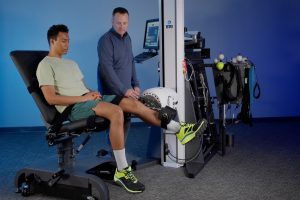
Isokinetic dynamometry measures maximal torque production at a specified velocity of limb movement. The system matches the subject’s effort while maintaining a set speed, and both concentric and eccentric muscle contractions can be assessed. It’s long been considered the standard for isolated joint-strength measurement.
Handheld dynamometry offers a portable, more affordable option. Clinicians use handheld devices for isometric strength testing, with either “make tests” (the patient pushes against a stationary device) or “break tests” (the clinician overcomes the patient’s resistance).
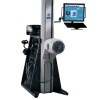
Multi-modal dynamometry is where things get interesting. Rather than being limited to a single resistance mode, systems like the BTE PrimusRS allow clinicians to evaluate and rehabilitate using isotonic, isometric, isokinetic, and CPM resistance modes, all on one platform. This means you’re not just testing isolated strength in one plane. You’re capturing a fuller picture of how the athlete produces and controls force across multiple movement patterns.
Why Manual Muscle Testing Falls Short
If you’re still using manual muscle testing as your primary strength measure for return-to-sport decisions, it’s time to reconsider. The limitations are well-documented and clinically significant.
Muscles can lose a substantial portion of their predicted strength and still receive a “normal” grade on the Oxford Scale. A 5/5 score tells you the patient can resist the force you’re applying, but it tells you nothing about how that limb compares to the other side, how force is produced through the full range of motion, or whether the athlete can generate force at the speeds their sport demands.
There’s also the clinician strength ceiling. When you’re testing a 220-pound linebacker or a competitive powerlifter, your ability to manually resist their effort becomes the limiting factor, not their actual strength.
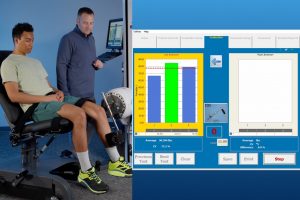
From a business perspective, subjective grading undermines your documentation. Payers want quantifiable data. Referring surgeons want objective evidence that their patient met clearance criteria. BTE’s integrated reporting helps clinicians capture objective strength and functional data and generate automated reports that support reimbursement justification and referrer communication.

Key Metrics That Matter: Beyond Peak Torque
A dynamometry test that only captures peak torque is leaving critical information on the table. Here are the metrics that separate a basic strength test from a true return-to-sport assessment. The PrimusRS helps clinicians track these objective measurements over time, documenting progress at each milestone.
Limb Symmetry Index (LSI)
LSI is the most widely used return-to-sport metric. It compares the involved limb’s strength to the uninvolved side. Clinicians commonly use progressive LSI thresholds as milestone gates throughout rehab, with higher thresholds required at each stage before advancing to more demanding activities.
Agonist-Antagonist Ratios
The hamstring-to-quadriceps ratio is a classic example. Adequate balance between opposing muscle groups reduces joint stress during athletic movements. What’s particularly valuable is distinguishing between conventional ratios (concentric hamstring vs. concentric quadriceps) and functional ratios (eccentric hamstring vs. concentric quadriceps), which better reflect the deceleration demands of sport.
Work-Based Ratios
Peak torque can be skewed by a single compensatory push. Work-based ratios, which integrate torque across the full range of motion, provide a more consistent and representative picture of strength capacity. BTE’s multi-mode resistance capability makes these deeper analyses possible within a single testing session.
Rate of Force Development
How quickly an athlete can generate force matters enormously for cutting, jumping, and sprinting. Rate of force development is increasingly recognized as a key return-to-sport indicator, particularly for athletes returning to explosive sports.
Endurance and Fatigue Characteristics
Extending your testing beyond a few maximal reps reveals how strength holds up under fatigue. This is critical for sport-specific conditioning clearance, because games aren’t played in three-rep sets.
Standardizing Your Testing Protocols
One of the biggest challenges in dynamometry testing for return to sport is consistency. Without standardized protocols, your data loses its meaning.
Test at multiple speeds. A typical return-to-sport battery includes isokinetic testing at slow, moderate, and high speeds. Deficits may only appear at certain velocities, so testing at a single speed can miss meaningful asymmetries.
Include eccentric testing. Eccentric strength is essential for deceleration and change-of-direction capacity. If you’re only testing concentrically, you’re missing half the picture. The PrimusRS supports both concentric and eccentric isokinetic testing across upper and lower extremity joints.
Use sufficient repetitions. True peak torque rarely appears in the first few reps. Higher-rep sets also allow you to evaluate endurance characteristics.
Normalize to body mass. Expressing strength data relative to body weight enables meaningful cross-patient comparison and helps establish sport-specific benchmarks.
Choosing the Right Approach for Your Clinic
The traditional debate frames this as a binary choice: expensive isokinetic systems versus limited handheld devices. But that framing misses the point.
Isokinetic-only platforms deliver excellent isolated joint data, but they were never widely adopted as functional rehabilitation systems. They remain primarily single-purpose devices. Handheld dynamometry is portable and affordable, but it’s limited to isometric measurement and dependent on examiner positioning.
The real question isn’t which single modality is the answer. It’s how you integrate objective measurement into every stage of the rehab continuum, from initial evaluation through return to sport.
This is where the BTE PrimusRS changes the conversation. It combines the features of multiple machines into one compact system, capturing real-time objective data across isotonic, isometric, isokinetic, and CPM resistance modes. You evaluate, rehabilitate, and document on a single platform. Specialized attachments allow you to isolate joint movements on both upper and lower extremities, and replicate sport-specific activities. For clinics that also need portable testing capacity, BTE’s evaluation suite extends objective measurement into industrial rehab and job-site settings.
Beyond the Knee: Don’t Forget Upper Extremity
A lot of return-to-sport content focuses on ACL rehab and lower extremity testing. But upper extremity assessment is equally important for throwing athletes, overhead sport athletes, and swimmers, and it’s far less standardized.
Internal and external rotation ratios, grip strength, and multi-joint functional testing all benefit from objective dynamometric measurement. PrimusRS is one of the few platforms that supports multi-joint upper and lower extremity evaluation from a single system, which matters for clinics serving diverse sport populations.
The Business Case You Can’t Ignore
For clinic owners and administrators, dynamometry testing for return to sport isn’t just a clinical upgrade. It’s a business differentiator.
Objective data strengthens your documentation for reimbursement. It builds referrer confidence when surgeons see quantified clearance criteria in your reports. It standardizes protocols across multi-site operations. And the same platform that drives your return-to-sport testing can power functional capacity evaluations and return-to-work testing, creating multiple revenue streams from one investment.
Closing Thought: Elevating Your Standard of Care
The field has moved. Time-based clearance and subjective grading are no longer defensible as standalone approaches. Dynamometry testing for return to sport gives you the objective backbone your clinical decisions need, and your patients deserve.
Whether you’re serving post-surgical athletes, weekend warriors, or occupational health populations, integrating objective dynamometric measurement into your practice transforms outcomes, protects patients, and builds your clinic’s reputation.
It starts with evaluating your current return-to-sport protocols, identifying where you’re relying on subjective judgment, and exploring how an integrated, multi-modal platform can close those gaps. BTE’s PrimusRS was built to help clinicians do exactly that: get patients back to life, work, and play.