Applying Isotonic Movement Concepts in Patient Rehabilitation
Treatment Guidelines
Learn how isotonic movement concepts boost rehab success, improve outcomes, and empower patients in recovery.
Isotonic exercise is fundamental to physical therapy practice, yet its application varies widely across clinics. Therapists understand the basics of progressive isotonic prescription, but translating that knowledge into systematic protocols can be a challenge.
This article reviews the fundamentals of isotonic movement, application in condition-specific protocols with advanced programming variables, and considerations for complex cases. We also provide clinical tools that help therapists confidently integrate isotonic progressions into treatment.
Fundamentals of Isotonic Movement in Rehabilitation
Isotonic movements are muscular contractions against a set amount of resistance throughout a range of motion. In the clinic or gym, isotonic movements are a bicep curl or a squat. For people at home, they’re lifting a water bottle to the mouth or sitting on a garden stool.
Muscles that perform isotonic movements can contract in one of two ways: concentrically or eccentrically.
- Concentric: An isotonic movement where the muscle shortens, often moving weight against gravity. A concentric quadriceps contraction would be standing up from a chair.
- Eccentric: An isotonic movement where the muscle lengthens, often controlling weight with gravity. An eccentric quadriceps contraction would be squatting to sit in a chair.
Isotonic vs Isometric vs Isokinetic Exercise
Isotonic movements are the most common types of exercises performed in the clinic because they closely mimic everyday tasks. However, patients at other stages of rehab may benefit from incorporating other types of muscle contractions to achieve better outcomes.
Isometric exercises cause the muscle to contract without movement. The muscle creates tension against resistance, but the resistance doesn’t move through a range of motion. For example, if you stand on your tiptoes and hold for 30 seconds, you’re isometrically contracting your calf muscles. These exercises are often helpful for training joint stabilization in the early rehabilitation stages, with a lower risk of pain provocation.
Isokinetic exercises cause the muscle to contract at the same speed throughout a range of motion. Usually, these exercises are performed on specialized equipment that can standardize the rate of movement for a true isokinetic contraction. In the clinic, a patient may perform elbow flexion and extension against the machine’s arm, which controls how quickly they move through the full range of motion as they apply force. Many machines can provide objective data on muscle strength throughout the movement, which helps inform evaluations or guide treatment.
Each type of contraction has a time and place. For this article, we’ll focus on how to utilize isotonic movements effectively during rehabilitation.
The Science Behind Isotonic Rehab
Isotonic movements can be a powerful tool throughout every stage of rehabilitation when applied carefully and intentionally. To be successful, you should be familiar with the two core principles involved in isotonic rehabilitation: progressive overload and neuromuscular adaptation.
Progressive overload is when you incrementally increase stress on the muscle. The most common way to increase muscle stress is to increase weight gradually, but you can also achieve progressive overload by manipulating repetitions, distance, or tempo.1 To avoid injury or pain provocation, you would change one variable at a time and monitor symptoms closely with every training volume adjustment.
The purpose of progressive overload is to encourage neuromuscular adaptation, or the physiological changes in nerves and muscles during resistance training. The goal of progressive isotonic exercise is to remodel the neuromuscular system to handle higher loads that may occur in a patient’s everyday life.2 In other words, patients will feel strong enough to face the daily challenges of their activities of daily living (ADLs), like lifting boxes in their garage or shoveling snow from their driveway.
Building Evidence-Based Isotonic Protocols
Isotonic exercise progressions depend on several factors, including the patient’s diagnosis and goals. While the physical therapist uses their clinical judgement to decide which progression is best, some progressions are guided by surgical protocols.
Let’s discuss typical condition-specific isotonic protocols and advanced programming considerations.
Condition-Specific Isotonic Protocols
Some conditions have evidence-based isotonic protocols that guide rehabilitation efforts. Knee osteoarthritis, rotator cuff repairs, and anterior cruciate ligament (ACL) reconstructions are three common examples we see in the clinic.
Knee osteoarthritis also benefits from isotonic progressions. Research suggests that isotonic exercise can help relieve pain and stiffness while restoring strength and function. Low-load isotonic exercises are most effective in improving muscle strength. At first, this low-load isotonic training may begin with minimal resistance through comfortable ranges of motion (like partial squats or knee extension arcs) for high repetitions. You can carefully progress a variable once the patient is ready, such as range of motion, resistance, or tempo, toward functional goals.3
Rotator cuff repair protocols may vary depending on tear size, tissue quality, the number of tendons involved, and comorbidities. Protecting healing tissues and restoring passive range of motion are the main priorities in the early phases. Strengthening begins with rotator cuff isometrics and scapular strengthening at around six and 12 weeks, depending on the protocol. Soon after, the patient can begin rotator cuff-specific isotonic movements to challenge the muscle through the shoulder’s range of motion. These movements can be progressed using any method — adding resistance or adjusting tempo — but the patient must be pain-free to avoid straining the involved tissue and follow the surgeon’s protocol.4
ACL reconstructions follow a similar procedure. Early phases focus on protecting the graft, reducing swelling, and restoring full tibiofemoral and patellofemoral mobility. Strengthening begins between zero and two weeks, primarily focusing on quadriceps, calf, and hip strength. These muscle contractions begin as isometrics, which improve muscle recruitment. As the patient becomes more coordinated, they can start isotonic exercise progressions, provided it follows the surgeon’s movement protocol to avoid stress on the graft. If the reconstruction was an autograft (e.g., hamstring), the therapist may wait at least six weeks before any strengthening at the harvest site, depending on the protocol.5
Advanced Programming Variables for Rehab
Once you’ve established a condition-specific isotonic protocol, you can fine-tune your exercise dosing to optimize rehab outcomes. Manipulating tempo, applying periodization models, and prescribing rest intervals are three common ways to do so.
Manipulating movement tempo can provide sufficient stress to a muscle tendon to promote tendon remodeling, which promotes collagen synthesis and overall tendon health. Specifically, eccentric isotonic loading plays a significant role in tendon injury prevention and can be a valuable tool in rehabilitation. This is especially true in older adults who may be sensitive to load. Progressive eccentric training has a lower perceived exertion than other forms of training (even though the training load is higher).6
Applying periodization models structures exercise progressions through phases. You can choose linear or undulating periodization based on the patient and their condition, though both have their benefits and can enhance muscle adaptation. For example, a surgical protocol may follow a more linear periodization model to ease into rehabilitation while protecting healing tissues. But research suggests that novel or variable stimuli, rather than the patient’s typical training patterns, may offer the greatest benefit. If a patient reports a history of linear isotonic progression in the gym, introducing an undulating periodization model could yield greater strength gains.7
Prescribing rest intervals to manage fatigue during isotonic protocols can enhance rehabilitation outcomes. Not only does rest protect against overtraining, but it can also prevent early fatigue and regulate growth hormone release depending on the resistance training goals. Research suggests that training for absolute strength should incorporate resting periods of three to five minutes between sets, while hypertrophy training should incorporate resting periods of 30–60 seconds. Evidence isn’t as clear regarding rest periods for muscular endurance, though shorter periods of 20 seconds to one minute may prevent early fatigue.8
Objective Measurement and Tracking for Isotonic Rehab
A physical therapist can use objective tools and patient-reported outcome measures to quantify the results of an isotonic training regimen.
Quantifying Progress with Objective Tools
Dynamometers and functional movement screening (FMS) are two tools that can help objectively quantify patient progress.
- Dynamometers: These tools measure force output during an isolated movement. Measurements can be used to evaluate a patient and track progress over time. For example, a physical therapist may measure a soccer player’s hamstring and quadriceps strength after an ACL reconstruction to determine strength ratios for return to play.
- FMS: This tool quantifies the quality of movement through a series of tests recorded on a scoring sheet. Scores can be tracked at every reevaluation to assess movement pattern efficiency and readiness for return to sport. A physical therapist may administer FMS to the same patient as the ACL reconstruction to provide additional data on their confidence in performing whole-body movement patterns (as seen in ADLs and sports).9

Integrating Patient-Reported Outcome Measures
Patient-reported outcome measures (like the DASH or LEFS) are also valuable tools for understanding how patients feel about their progress, where they lack confidence, and how to progress toward functional goals.
As you progress a patient’s isotonic training regimen, evaluating the patient’s perceived outcomes tells you if strength gains are improving ADLs. From there, you can make exercise prescription adjustments specific to any remaining deficits. You may choose to regress specific exercises if your patient reports a decline in function. Or if they report a functional plateau, it could be a sign to adjust your isotonic strengthening protocol by changing a variable or applying advanced programming variables (as discussed earlier).
Special Considerations and Troubleshooting
Isotonic protocols may need to be modified for specific populations. Clinicians must recognize when traditional isotonic progressions aren’t working.
Modifications for Complex Patient Populations
Complex patients may have different progression considerations compared to typical populations. Here are a few evidence-based examples.
- Neurological deficits: According to research, eccentric strength is better preserved than concentric strength during a stroke and shows a larger cross-transfer effect to the untrained limb. Incorporating eccentric resistance training progressions could be a practical way to improve bilateral neuromuscular activation, strength, and walking speed following a stroke.10
- Joint hypermobility: While there is no gold standard exercise regimen for those with hypermobility spectrum disorder, the commonly accepted exercise prescription is low-dose training to stiffen muscles and tendons and promote joint stability. Although some research suggests heavy strengthening (full range of motion and high load) is acceptable under supervision, physical therapists should carefully judge when and how to increase load while keeping the patient safe. Rather than placing more weight on a joint, a therapist may decide to increase the load by slowing the eccentric phase of movement.11
- Osteoporosis: Physical therapists may need to consider contraindications for specific populations during isotonic training. People with osteoporosis should avoid loaded spinal flexion or twisting movements to reduce the risk of vertebral fractures. During isotonic training, proper form should be the top priority and primary criterion for any progressions. Those with osteoporosis should also avoid high-impact activities. Progressing isotonic training with plyometric movements is not appropriate.12
Managing Common Clinical Challenges
If a patient plateaus, flares, or isn’t progressing as expected, you may need to troubleshoot.
A plateau may signal muscle adaptation and underdosing isotonic training. In this case, apply the overload principle by adjusting a variable to the current exercise regimen or consider changing the periodization model to introduce new stimulus.
A flare may indicate progressing too quickly or adjusting too many variables at once. The best course of action is to control irritation by regressing the training regimen by a variable at a time until the patient can perform the movement symptom-free, then gradually progress one variable at a time.
Practical Tools and Resources for PT Directors
Translating isotonic principles into clinical practice requires systematic decision-making tools, streamlined documentation, and an understanding of real-world application.
The Clinic-Ready Isotonic Decision Matrix
Help your physical therapists by providing an isotonic decision matrix that guides treatment progression. This is a simple reference point for therapists who want to apply isotonic exercise but need to brainstorm on where to start. Here’s an example you can use in your clinic.
| Phase | Irritability | Exercise | Reps and Load | Progress |
| Acute | High | Isometrics, introduce isotonics (slow eccentrics) | High reps (12–15), light load | When pain is 0–3 out of 10 for a few sessions |
| Subacute | Moderate | Slow tempo isotonics | Moderate reps (10–12), moderate load | No flare with improving perceived exertion |
| Chronic | Low | Standard tempo isotonics | Low reps (6–8), heavy load | Consistently |

Compliance and Documentation Templates
Showing objective data in notes helps show the efficacy of skilled treatment and the medical necessity of continued care. Documentation should be structured around measurable change and directly applied to functional improvements to show value-based care.
Consider providing a few templates to make documentation easier and more consistent across clinic documentation. Here’s an example you can use.
[Insert objective measurement] has improved by [rate of improvement]. Patient can now do [functional activity] without [assistance level or perceived exertion report]. Further intervention is needed to address [impairment] and improve [functional activity] for safe discharge.
Real-World Examples
Consider providing real-world case studies, either from the clinic or a research article. Here’s a fictitious (but possible) example to work through as a team.
Patient: A 52-year-old female is eight weeks post-rotator cuff repair (supraspinatus).
Problem: The physical therapist progressed the patient to 3 sets of 12 reps of shoulder external rotation with a three-pound dumbbell at week seven. Patient reported sharp pain during the exercise and increased pain for three days.
Decision making: Flare indicates that the load exceeded tissue capacity. Tissue irritability is elevated, indicating the need for regression.
Solution: Discuss as a team what to do next. Consider the following course of action:
- Reduce load to the highest tolerated amount (perhaps two pounds).
- Modify tempo with an eccentric focus.
- Maintain volume and frequency if possible.
- Keep pain to a minimum (two or lower on the visual analog scale).
Progression: Discuss as a team the steps to progress once again. Consider the following course of action:
- After two weeks, reintroduce the three-pound dumbbell at a standard tempo.
- If no flare is reported, progress to five pounds by 11–12 weeks.
BTE’s PrimusRS with Isotonic Resistance
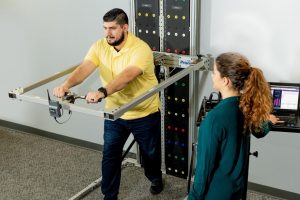
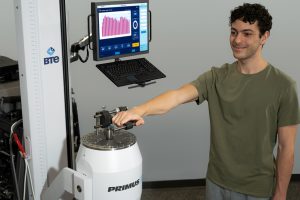
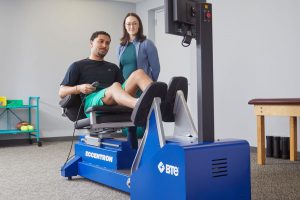
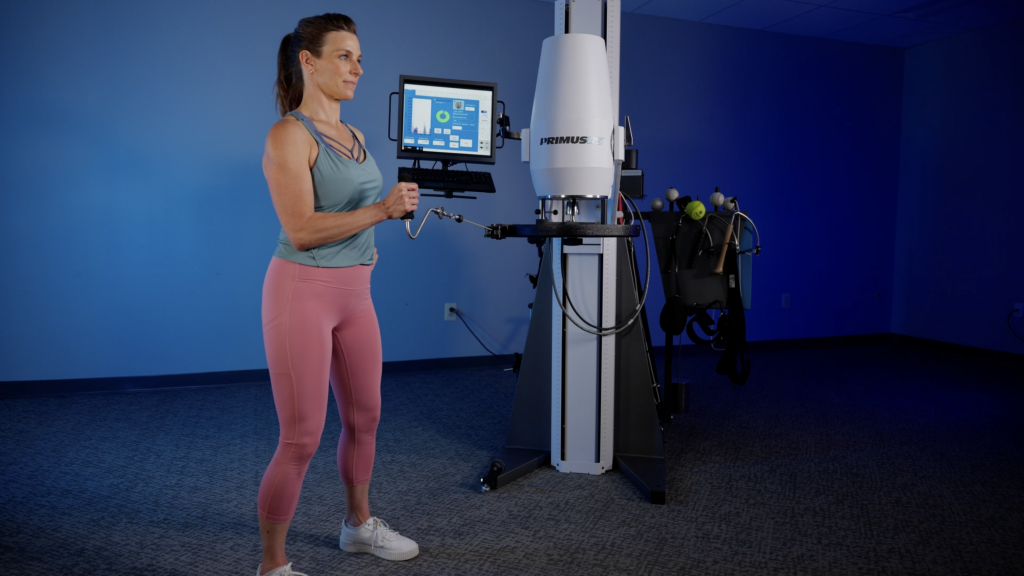
While isotonic exercises can be performed with standard equipment, specialized technologies like BTE’s PrimusRS allow clinicians to provide precise exercise prescriptions with objective measurements.
The PrimusRS can unsynchronize concentric and eccentric contractions, enabling therapists to set unequal forces and deliver targeted dosing to maximize patient outcomes. It’s also an evaluation tool that can provide a snapshot of patient performance for more accurate data tracking and documentation, including torque and speed across a joint’s range of motion. With isotonic resistance, PrimusRS can simulate functional tasks your patient may need to return to work. Learn how to simulate the demands of HV/AC workers
More precise exercise prescription and accurate tracking of patient performance provide therapists with valuable insight regarding treatment efficacy and progression.
Conclusion
Effective isotonic protocols require more than simply prescribing squats and rows. It demands evidence-based progressions and continuous fine-tuning based on objective data and patient outcomes.
As you consider the approaches in this article, remember that clinical judgement is key in determining the best isotonic movement progressions for your patient and their specific condition. The BTE PrimusRS can support you by providing precisely administered exercises and objective data, helping your therapists to guide patients from injury to recovery.
Nicole Hernandez, PT, DPT earned her doctorate in physical therapy from Campbell University. She worked in an outpatient orthopedic setting for several years before transitioning to a full-time career in health writing. Now, she contributes articles and educational content to clinics, hospital systems, and healthcare organizations across the United States, helping clinicians and patients make informed decisions about their care.