Transform your orthopedic rehabilitation practice with evidence-based protocols, objective outcome tools, and proven strategies that drive both clinical excellence and business growth. Discover the modern playbook for PT success.
Modern orthopedic rehabilitation demands more than traditional manual therapy—it requires objective data, evidence-based protocols, and integrated technology. This guide shows you how to build a high-performing ortho rehab program that delivers superior patient outcomes while driving clinic growth. Learn how to leverage objective testing, advanced modalities like BFR training, and data-driven workflows to differentiate your practice, improve reimbursement, and prove your value to referral sources.
Core Principles for a High-Performing Clinic
Principle 1: Individualized Care as Your Differentiator
Today’s successful orthopedic rehab starts with truly individualized treatment planning. In many clinics, double-booking has quietly become the norm—but it’s one of the biggest threats to delivering truly individualized care. When a therapist is managing multiple patients at once, treatment inevitably shifts from skilled intervention to supervised exercise. Clinics that commit to true one-on-one care create space for deeper assessment, precise decision-making, and the kind of measurable outcomes that set them apart to patients and referral sources.
What This Looks Like in Practice:
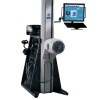
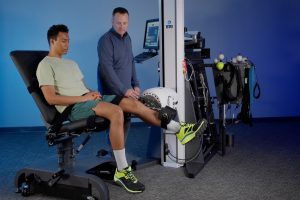
Instead of generic protocols, you’re creating data-driven, patient-specific programs. When evaluating a post-operative rotator cuff patient, you’re not just noting “weakness”—you’re capturing objective strength measurements across multiple planes of motion. Systems like the PrimusRS allow you to quantify baseline deficits and track precise improvements throughout care. That level of personalized care isn’t possible when attention is divided; individual care thrives when each patient receives a dedicated, uninterrupted session tailored to their goals and objective findings.
Why This Matters:
- For Your Business: Market “personalized recovery plans backed by objective data” to attract both patients and physician referrals
- For Your Clinicians: Achieve faster, more meaningful progress by targeting specific deficits rather than following generic timelines
Principle 2: Goal-Setting That Drives Reimbursement
Clear, measurable, functional goals aren’t just good clinical practice—they’re essential for reimbursement and patient engagement.
The New Standard:
Replace vague goals like “improve strength” with specific, objective targets: “Increase shoulder flexion strength from 12 lbs to 20 lbs as measured by isometric testing to enable overhead reaching for work tasks.” This specificity transforms your documentation from subjective notes into defensible progress reports.
The Business Impact:
- Justify continued care with data-backed progress toward established benchmarks
- Reduce claim denials by providing objective evidence of medical necessity
- Keep patients motivated with visible, measurable milestones
Principle 3: Interdisciplinary Collaboration for System-Wide Success
Your orthopedic rehab program doesn’t exist in isolation. Success requires seamless communication between PTs, OTs, surgeons, case managers, and payers.
Building Your Collaborative Framework:
Implement standardized evaluation protocols that generate reports everyone understands. When your entire team—from the orthopedic surgeon to the work comp case manager—receives the same objective data formatted consistently, care coordination improves dramatically.
For larger health systems, this standardization becomes even more critical. Tools like EvalTech help you create practice-wide consistency in functional testing, ensuring every clinician delivers the same high-quality assessments with automated, professional reporting.

The Modern Toolkit: Integrating Technique with Technology
Foundational Techniques, Objectively Measured
Therapeutic exercise and manual therapy remain the cornerstones of orthopedic rehabilitation. But here’s what’s changed: we can now quantify their effectiveness with unprecedented precision.
The Evolution of Exercise Prescription:
Traditional approach: “Perform 3 sets of 10 repetitions with resistance band”
Modern approach: “Perform 3 sets of 8 repetitions at 60% of maximum isometric strength (18 lbs) with 2-second eccentric phase”
This precision isn’t about complexity—it’s about reproducibility and progression. When you can measure exact force production, range of motion, and movement quality, you can optimize every session for maximum benefit.
Advanced Modalities for Accelerated Outcomes
Eccentric Training Protocols
Eccentric exercise offers unique advantages for orthopedic rehabilitation. The Eccentron system lets you harness these benefits safely, providing controlled eccentric resistance that builds strength while minimizing cardiovascular stress—ideal for deconditioned post-surgical patients.
Eccentric training:
- Produces greater strength gains than concentric exercise alone
- Reduces oxygen consumption and perceived exertion
- Allows higher loading capacity for weakened muscles

The Technology Revolution in Rehab
Objective Testing: Your Gold Standard
Manual muscle testing served us well for decades, but it can’t meet today’s documentation demands. Modern objective testing systems provide the reliable, repeatable data that payers, physicians, and patients expect.
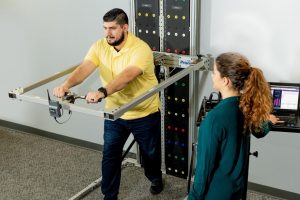
Consider return-to-work decisions. When an employer asks if their injured worker can safely return to a job requiring repetitive lifting, subjective assessments won’t suffice. You need objective data showing the employee can maintain specific force production levels through functional movement patterns. The Prism system provides FCE-ready testing in a compact footprint, perfect for clinics needing professional-grade evaluation capabilities without dedicating entire rooms to testing equipment.
Telerehabilitation: Expanding Access and Ensuring Adherence
Telehealth isn’t just a pandemic-era stopgap—it’s a permanent fixture in orthopedic rehabilitation. Smart integration of remote care can:
- Increase patient adherence through convenient follow-ups
- Expand your service area beyond geographic constraints
- Improve efficiency by reserving in-clinic time for hands-on treatment
Mastering the Rehab Continuum: From Pre-hab to Performance
Phase 1: Pre-Surgical Optimization
Prehabilitation might be your most underutilized opportunity. Patients who undergo structured pre-surgical rehab achieve better post-operative outcomes.
Your Prehab Protocol:
- Establish baseline objective measurements for strength, ROM, and function
- Implement targeted strengthening and mobility work
- Educate patients on post-operative expectations and home program compliance
- Build rapport that ensures they return to you post-surgery
This early relationship-building creates a natural referral pipeline while optimizing surgical outcomes—a win for patients, surgeons, and your practice.
Phase 2: Post-Surgical Recovery
The acute and subacute phases demand careful progression management. This is where objective data truly shines.
Data-Driven Progression:
Instead of advancing based solely on timeframes, use objective markers:
- Progress from isometric to isotonic exercises when specific strength thresholds are met
- Advance weight-bearing based on measured load tolerance
- Initiate sport-specific training when strength symmetry reaches established criteria
Systems like the Multi-Cervical Unit provide this objective guidance for cervical spine patients, helping you safely progress through post-surgical protocols with confidence.

Phase 3: Functional Return
Return-to-Work Readiness
For workers’ compensation cases, your documentation can make or break a claim. Objective functional capacity evaluations (FCE) provide the defensible data that case managers and employers need.
Your RTW assessment should include:
- Job-specific functional testing matching actual work demands
- Sustained capacity measurements demonstrating work tolerance
- Clear, objective reports that eliminate ambiguity
Functional evaluation systems like Prism have everything you need to perform FCEs, return-to-work evaluations, and more occupational rehab testing.

Return-to-Sport Criteria
Athletes need more than time-based clearance. They need objective proof they’re ready to perform. This includes:
- Strength symmetry testing (typically requiring 90% or better limb symmetry)
- Power production assessments
- Sport-specific movement analysis
- Comparison with normative data for age, gender, and sport-specific comparisons
When athletes are ready for return-to-sport evaluations, PrimusRS provides isokinetic testing as well as sport-specific task simulation for a data-driven RTS decision.
Watch: Return to Sport Testing on PrimusRS
The Business of Ortho Rehab: Proving Value and Winning Contracts
Data as Your Primary Asset
Your outcomes data isn’t just clinical documentation—it’s your most powerful business tool.
Leveraging Aggregate Outcomes:
- For Payer Negotiations: Show superior outcomes compared to regional averages to justify higher reimbursement rates
- For Physician Relations: Demonstrate consistent results that build referral confidence
- For Corporate Contracts: Prove faster return-to-work times and reduced reinjury rates
Automating Your Winning Workflow
Efficiency drives profitability. Integrated technology streamlines your entire workflow:
- Initial Evaluation: Objective testing systems capture baseline data and generate professional reports automatically
- Progress Documentation: Regular retesting provides objective progress notes with minimal therapist time investment
- Discharge Planning: Comprehensive outcome reports justify care provided and support transition planning
This automation doesn’t replace clinical judgment—it enhances it. When you spend less time on documentation, you have more time for patient care and practice growth.
Your Next Steps: Building Tomorrow’s Orthopedic Rehab Practice
Success in modern orthopedic rehabilitation requires more than clinical expertise. You need objective data to prove your value, efficient workflows to maximize profitability, and differentiated services to stand out in a competitive market.
The clinics thriving today aren’t just treating injuries—they’re proving outcomes. They’re not following generic protocols—they’re delivering personalized, data-driven care. They’re not hoping for referrals—they’re earning them with objective results.
Your orthopedic rehab program has the potential to become the regional standard for excellence. The question isn’t whether to modernize—it’s how quickly you can implement these changes to capture the growing demand for evidence-based, objective rehabilitation.
Ready to transform your orthopedic service line? Discover how BTE’s integrated evaluation and rehabilitation systems help you standardize protocols, capture objective outcomes, and grow your practice. Explore our complete orthopedic rehab solutions and see why leading clinics choose BTE for objective, reliable results.
Orthopedic Rehabilitation Physical Therapy FAQs for PT & OT Clinic Staff
Q: What’s the difference between acute, subacute, and chronic phases of orthopedic rehabilitation, and how should treatment approaches change?
A: The acute phase (0-72 hours post-injury) focuses on pain management, inflammation control, and protection using RICE protocol or PEACE and LOVE and gentle range of motion. The subacute phase (3 days to 6 weeks) emphasizes restoring mobility, beginning strengthening exercises, and introducing manual therapy techniques. The chronic phase (6+ weeks) concentrates on advanced strengthening, functional training, and sport/work-specific activities. Treatment intensity and complexity should progressively increase through each phase while monitoring patient response and avoiding re-injury.
Q: When should we use manual therapy versus therapeutic exercise in orthopedic patients?
A: Manual therapy is most effective during acute and subacute phases for pain relief, improving joint mobility, and addressing tissue restrictions. Use it when patients have limited range of motion, joint stiffness, or soft tissue adhesions. Therapeutic exercise becomes primary during subacute and chronic phases for building strength, endurance, and functional movement patterns. The best approach often combines both – use manual therapy to prepare tissues, then follow with exercises to maintain gains and build upon improvements.
Q: How do we determine appropriate progression criteria for orthopedic patients?
A: Base progression on objective measures including pain levels (should be 3/10 or less during activity), range of motion improvements, strength gains (measured via manual muscle testing or dynamometry), and functional improvements. Key indicators include: patient can perform current exercises with proper form and without increased pain, demonstrates 75-80% completion of range of motion goals for that phase, shows strength improvements of 10-15% from baseline, and reports improved function in daily activities. Always progress gradually – typically 10-20% increases in intensity, duration, or complexity.
Q: What are the most important patient education topics we should cover for orthopedic conditions?
A: Focus on: proper body mechanics and posture during daily activities, understanding their specific condition and healing timeline, home exercise program compliance and proper technique, activity modification strategies to prevent re-injury, pain vs. harm education (distinguishing between therapeutic discomfort and harmful pain), and ergonomic principles for work/home environments. Also educate on warning signs that require immediate attention, such as increased swelling, severe pain, or loss of function.
Q: How should we modify treatments for patients with multiple orthopedic conditions or comorbidities?
A: Prioritize the most limiting condition first while considering how treatments affect secondary conditions. For multiple joint involvement, use exercises that address several areas simultaneously when possible. With comorbidities like diabetes or cardiovascular disease, monitor vital signs more closely and adjust exercise intensity accordingly. Consider contraindications – avoid certain modalities or positions based on medical history. Coordinate with physicians and other healthcare providers, and always start conservatively with shorter sessions and lower intensities, progressing based on patient tolerance.
Q: What documentation is essential for orthopedic rehabilitation to ensure compliance and optimal patient outcomes?
A: Document initial evaluation findings including mechanism of injury, pain scales, range of motion measurements, strength testing results, and functional limitations. Record treatment interventions used, patient response to treatment, and any adverse reactions. Track objective progress measures session-to-session including ROM, strength, and functional improvements. Note patient education provided and home exercise program compliance. Document any modifications to treatment plan and rationale, communication with physicians or other providers, and discharge planning including return-to-work or sport recommendations. Ensure all documentation supports medical necessity and demonstrates skilled therapy services.