Rotator Cuff Rehab: Data-Driven Protocol for Clinic Growth
Treatment Guidelines
Improve your rotator cuff rehab program with clear, step-by-step protocols that boost outcomes, simplify documentation, and help your clinic grow.
Rotator cuff injuries affect millions annually, creating both a clinical challenge and business opportunity for rehab clinics. By implementing objective, data-driven rehabilitation protocols across four progressive phases (protective, mobility, strengthening, and functional return), clinics can improve patient outcomes while differentiating their practice.
Modern rehabilitation equipment like our products enables clinicians to quantify progress, standardize care, and demonstrate value to patients, payers, and referral sources.

The Rotator Cuff Challenge is Your Clinic’s Opportunity
Every year, nearly 2 million Americans seek medical care for rotator cuff injuries. As a clinic owner or practitioner, you’ve likely noticed these patients represent a significant portion of your caseload. But here’s what you might not have considered: your approach to rotator cuff rehabilitation could be the key differentiator that sets your practice apart in an increasingly competitive healthcare landscape.
The challenge isn’t just clinical; it’s operational. Many clinics still rely on subjective assessments and general exercise protocols that make it difficult to demonstrate progress, justify continued care to insurers, or prove value to referring physicians. When a patient asks, “Am I getting better?” or an insurer questions medical necessity, subjective observations rarely provide the compelling evidence you need.
This article provides a blueprint for implementing a modern, objective approach to rotator cuff rehabilitation that standardizes care, quantifies outcomes, and drives practice growth. We’ll show you how to transform your rotator cuff protocols from routine to remarkable, creating a program that benefits both your patients and your bottom line.
From Anatomy to Biomechanical Precision
Understanding the Complex Shoulder System
Your rotator cuff patients need more than basic exercises; they need targeted interventions based on biomechanical principles. The four rotator cuff muscles (supraspinatus, infraspinatus, teres minor, and subscapularis) work together as a dynamic stabilization system, not as isolated structures. This synergistic function, combined with proper scapular mechanics, forms the foundation of effective rehabilitation.
Understanding scapulohumeral rhythm isn’t academic minutiae; it’s practical knowledge that informs every exercise you select. When you observe compensatory patterns, such as excessive scapular elevation during arm raising, you’re witnessing biomechanical dysfunction that standard protocols might miss. This deeper understanding allows you to build protocols that address root causes, not just symptoms.
Moving Beyond Cookie-Cutter Approaches
The strategic advantage comes from applying this knowledge systematically. Instead of prescribing the same exercises for every rotator cuff patient, you can develop targeted interventions based on specific deficits. A patient with poor scapular control requires different emphasis than one with isolated supraspinatus weakness. This precision approach leads to faster recovery times and better functional outcomes, which translates directly to patient satisfaction and referral generation.
The Modern Rehab Blueprint: A Phased, Data-Driven Protocol
Phase 1: The Protective Phase (Pain and Inflammation Control)
Traditional approaches to the protective phase focus on passive range of motion, pendulum exercises, and pain management. While these remain valuable tools, the objective-driven approach adds measurable parameters that enhance both clinical decision-making and communication.
Goal: Protect the healing tissue while managing pain and initiating controlled mobility.
Objective Metrics: Digital inclinometry provides precise baseline measurements and ensures movement stays within surgeon-specified parameters. By tracking pain scores alongside objective mobility data, you validate that your interventions are working. For example, documenting that “passive flexion increased from 90 to 110 degrees with pain levels decreasing from 5/10 to 3/10” provides concrete evidence of progress.
Business Application: This objective documentation demonstrates protocol adherence to referring surgeons, building trust and encouraging continued referrals. For insurance purposes, these measurements justify the medical necessity of skilled intervention during this critical healing phase.
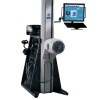
Systems like the PrimusRS enable clinicians to provide comprehensive shoulder evaluations as well as controlled passive motion and active shoulder exercises. This objective approach transforms the protective phase from a waiting period into an active, documented progression.
Goal: Systematically restore active range of motion without compensatory patterns.
Objective Metrics: Weekly documentation of active range of motion gains provides clear progression markers. By identifying specific movement deficits (such as limited external rotation versus adequate flexion), you can target interventions more effectively. This specificity improves efficiency and outcomes.
Clinical Application: Objective documentation simplifies progress notes and functional reporting. Instead of writing “patient demonstrates improved reaching,” you can document “shoulder flexion AROM increased by 20 degrees this week, now allowing overhead reaching for daily activities.” This clarity benefits everyone: patients understand their progress, insurers see medical necessity, and referring providers appreciate the detailed communication.
The ability to provide controlled, measurable resistance throughout the range of motion helps clinicians address specific mobility restrictions while building early-phase strength. Equipment like Simulator II that offers real-time feedback allows patients to understand their movement quality, improving motor learning and reducing compensatory patterns.

Phase 3: The Strengthening Phase (Building Resilient Strength)
The strengthening phase represents a critical transition where objective data provides the most value. Moving beyond resistance bands and subjective assessments, modern rehabilitation demands quantifiable strength measurements that guide progression and demonstrate readiness for functional activities.
Goal: Progressively load the rotator cuff and periscapular muscles with measurable, reproducible parameters.
Objective Metrics: Handheld or computerized dynamometry provides peak force measurements for internal and external rotation, establishing clear strength benchmarks. Setting objective goals, such as achieving 90% strength symmetry compared to the unaffected side, creates tangible targets for both clinician and patient.
Sports Medicine and Occupational Health Application: For athletes and workers, these strength measurements become the foundation for return-to-activity decisions. When you can demonstrate that a pitcher has restored external rotation strength to sport-specific requirements, or that a warehouse worker meets the lifting demands of their job, you provide defensible criteria that protect both the patient and your practice from liability concerns.
The PrimusRS assists clinicians in providing precise, measurable resistance training across multiple planes of motion. Its ability to quantify force output and track progress over time transforms strength training from guesswork into science. Additionally, systems like EvalTech help clinicians perform comprehensive functional assessments that document work-ready status with objective data.
Goal: Ensure patients possess the strength, power, and neuromuscular control required for their specific activities.
Objective Metrics: Sport-specific power measurements, reaction times, and job task simulation data provide concrete evidence of functional capacity. For overhead athletes, this might include throwing velocity and accuracy metrics. For workers, it could involve repetitive lifting capacity or sustained overhead work tolerance. BTE’s PrimusRS allows clinicians to simulate sport-specific movements like throwing in the clinic, while Prism simulates functional job tasks like lifting, repetitive reaching, and positional tolerance.
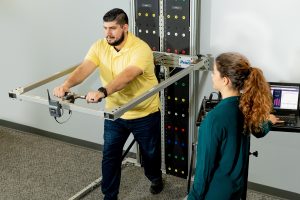
Business Application: This objective data becomes your competitive advantage. Occupational health clients value providers who can definitively clear workers for duty with supporting documentation. Sports programs seek rehabilitation providers who understand performance metrics and can communicate in their language. The ability to provide detailed functional capacity reports opens new referral streams and contract opportunities.

Where Your Practice Can Excel
Addressing the Psychological Component with Data
Fear of reinjury represents one of the biggest barriers to successful rehabilitation. Objective data provides powerful psychological benefits that subjective assessments cannot match. When patients see their strength measurements improve week by week, they gain confidence that transcends verbal reassurance.
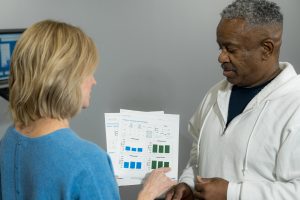
Consider the impact of showing a patient their external rotation strength graph trending upward over six weeks. This visual, objective proof of improvement combats anxiety and builds buy-in for continued rehabilitation. You’re not just telling them they’re getting better; you’re proving it with data they can understand and trust.
Precision Pain Management Through Load Monitoring
Modern pain management extends beyond modalities. By tracking pain responses to specific loads and volumes, you can precisely modify activities to maintain progress without triggering flare-ups. This approach requires objective measurement tools that capture both the stimulus (load/repetitions) and response (pain/fatigue).
For example, if you document that a patient tolerates 10 pounds of resistance for external rotation without pain increase but experiences symptoms at 15 pounds, you’ve identified their current tissue tolerance threshold. This information guides both in-clinic treatment and home exercise prescription, optimizing the healing environment while maintaining therapeutic stimulus.
Dynamic Exercise Progression Based on Capacity
Cookie-cutter timelines fail to account for individual healing rates and capacity differences. Objective testing enables progression based on actual tissue capacity rather than arbitrary timelines. A 25-year-old athlete might achieve strength benchmarks weeks before a 60-year-old office worker, and your protocols should reflect these differences.
Systems that provide instant feedback on force production and movement quality allow for real-time exercise modification. If a patient demonstrates fatigue-related form breakdown at repetition eight, you can adjust immediately rather than waiting for post-exercise soreness to indicate overload.
Consider developing a “Rotator Cuff Center of Excellence” program within your practice, complete with standardized protocols, outcome tracking, and regular reporting to referral sources. This specialized approach commands premium positioning in your market and justifies higher reimbursement rates for specialized care.
Optimizing Reimbursement and Proving Medical Necessity
Insurance denials often stem from inadequate documentation of progress and medical necessity. Objective data transforms your documentation from subjective observations to compelling evidence. When you submit progress notes showing quantified strength gains, measurable ROM improvements, and objective functional capacity increases, you provide insurers with clear justification for continued care.
Furthermore, objective testing supports higher-complexity billing codes. Manual muscle testing might support basic therapeutic exercise coding, but computerized strength assessment with detailed reporting justifies neuromuscular re-education and specialized testing codes that reimburse at higher rates.
Standardizing Care Across Multiple Locations
For hospital systems and multi-site practices, standardization ensures quality while simplifying operations. Objective protocols based on measurable benchmarks create consistency regardless of which therapist provides treatment. New staff members integrate more quickly when protocols include specific measurement parameters rather than subjective guidelines.
The Prism system offers compact, standardized testing capabilities that work well in multi-site implementations, ensuring consistent evaluation methods across locations. This standardization simplifies quality assurance, outcomes tracking, and staff training while maintaining high care standards.
When approaching potential occupational health clients, present your objective testing capabilities as risk management tools. Employers understand that objective return-to-work criteria reduce reinjury rates and workers’ compensation claims. Similarly, sports programs value providers who can quantify an athlete’s readiness with sport-specific metrics rather than general assessments.
Your Partner in Building a Better Rehab Practice
The future of rotator cuff rehabilitation belongs to practices that embrace objective, measurable approaches to care. By implementing the blueprint outlined in this article, you position your practice for both clinical excellence and business growth. Your patients benefit from better outcomes and clearer communication about their progress. Your practice benefits from improved reimbursement, stronger referral relationships, and competitive differentiation.
The transformation from subjective to objective rehabilitation doesn’t happen overnight, but each step toward measurable protocols strengthens your practice. Start by identifying one phase of your rotator cuff protocol where objective measurement would provide the most immediate value. Perhaps it’s strength testing in Phase 3 or functional assessment in Phase 4. Implement measurement tools, track outcomes, and use that data to refine your approach.
Ready to elevate your rotator cuff rehabilitation protocols with objective measurement tools?
Discover how BTE’s comprehensive line of evaluation and shoulder rehabilitation equipment can help you implement data-driven protocols that improve outcomes and grow your practice. Visit BTE’s product page to explore solutions designed specifically for modern rehabilitation practices.
Your commitment to objective, measurable rehabilitation excellence starts with the next rotator cuff patient who walks through your door. Armed with this blueprint and the right tools, you’re prepared to deliver care that sets new standards for your practice and your profession.
FAQs:
FAQ 1: What are the key contraindications during the protective phase of rotator cuff rehabilitation?
During the protective phase (0-6 weeks), avoid active shoulder flexion, abduction, or external rotation beyond prescribed limits. Do not allow patients to lift objects heavier than a coffee cup, support their body weight with the affected arm, or perform sudden, jerky movements. Internal rotation behind the back should be restricted, and patients should not sleep on the affected side. Always maintain immobilization protocols as specified by the surgeon, typically keeping the arm in a sling except during supervised therapy sessions.
FAQ 2: How do you differentiate between normal post-surgical pain and concerning complications during rehabilitation?
Normal post-surgical pain is typically localized to the surgical site, gradually decreases over time, and responds well to prescribed pain medications and ice. It’s usually worse in the morning and improves with gentle movement. Concerning signs include sudden, severe pain that’s different from baseline, numbness or tingling in the fingers, significant swelling or discoloration, fever, or pain that progressively worsens despite appropriate interventions. Any loss of previously gained range of motion or strength, or inability to perform previously tolerated exercises, warrants immediate communication with the referring physician.
FAQ 3: What’s the proper progression for introducing strengthening exercises in rotator cuff rehabilitation?
Begin with isometric exercises in pain-free positions during weeks 6-8, starting with the arm supported. Progress to isotonic exercises using gravity as resistance (arm supported on table), then advance to light resistance with elastic bands or 1-2 pound weights around weeks 10-12. Focus on high repetitions (15-20) with low resistance initially. External rotation and scapular stabilization exercises should precede internal rotation strengthening. Always ensure pain-free range before adding resistance, and maintain proper scapular mechanics throughout all exercises.
FAQ 4: How should you modify treatment if a patient develops adhesive capsulitis during rotator cuff rehabilitation?
If adhesive capsulitis develops, prioritize aggressive passive range of motion and joint mobilization techniques while respecting tissue healing constraints. Increase treatment frequency if possible, and emphasize home exercise program compliance with frequent, gentle stretching throughout the day. Consider modalities like moist heat before stretching and ice after to manage inflammation. Communicate immediately with the physician about potential corticosteroid injection or manipulation under anesthesia. Document range of motion measurements weekly to track progress and adjust treatment intensity accordingly.
FAQ 5: What are the specific return-to-work criteria for patients with different job demands following rotator cuff repair?
For desk jobs, patients typically need 90% passive range of motion, ability to position arm for keyboard use, and tolerance for 4-6 hours of arm positioning. For manual labor, require full active range of motion, 85% strength compared to unaffected side, and ability to lift 20-50 pounds depending on job requirements. Overhead workers need full overhead reach with good scapular control and endurance for sustained positioning. All patients should demonstrate functional movement patterns specific to their job tasks during therapy sessions before clearance. Consider work conditioning programs for high-demand occupations.
FAQ 6: How do you address patient non-compliance with sling use and activity restrictions during the protective phase?
First, assess understanding by having the patient explain the restrictions back to you and the consequences of non-compliance, including potential re-tear requiring revision surgery. Provide written instructions with clear timelines and visual aids showing proper sling positioning. Address practical concerns like sleeping comfort, personal hygiene, and work modifications. Involve family members in education sessions when possible. For persistent non-compliance, document thoroughly, communicate with the referring physician, and consider more frequent therapy visits for monitoring. Emphasize that early aggressive activity can result in a failed repair requiring more extensive surgery.