Stroke Rehabilitation Best Practices: Clinical Guidelines
Treatment Guidelines
Improve stroke rehab outcomes with evidence-based practices, interdisciplinary care, and actionable strategies for clinic and rehab leaders.
Stroke Rehabilitation Best Practices for Clinics
Effective stroke rehabilitation requires more than clinical expertise; it demands operational efficiency, objective measurement, and strategic program development. This guide bridges evidence-based protocols with practical implementation strategies, covering interdisciplinary coordination, early intervention timing, task-specific training approaches, technology integration, and continuum of care management.
Learn how to build a stroke program that delivers superior patient outcomes while strengthening your clinic’s referral network and financial performance.
Beyond Clinical Best Practices
If you’re managing or working in a stroke rehabilitation program, you already know the stakes. Every patient represents a complex puzzle of motor deficits, cognitive challenges, and personal goals. But here’s what keeps many clinic owners and therapists up at night: knowing the best clinical practices isn’t enough anymore.
Today’s healthcare environment demands that we prove our value with hard data, maximize efficiency without sacrificing quality, and create programs that are both clinically excellent and financially sustainable. The good news? When you integrate the right approach with the right tools, stroke rehabilitation becomes not just a clinical service, but a strategic advantage for your organization.
This guide connects the dots between evidence-based stroke rehabilitation protocols and the operational excellence needed to implement them successfully. Whether you’re looking to reduce claim denials, improve patient throughput, or create a referral magnet program, we’ll show you how to build a system that works for everyone: patients, clinicians, and your bottom line.
Building a High-Performance Stroke Program
From Silos to Synergy: The ROI of Interdisciplinary Care
The most successful stroke rehabilitation programs share a common foundation: coordinated, interdisciplinary care. This isn’t just about having physical therapists, occupational therapists, and speech-language pathologists on staff. It’s about creating a unified team where each discipline’s expertise amplifies the others.
For clinic owners and administrators, this coordination represents more than clinical best practice; it’s a business differentiator. When your team operates with standardized communication protocols and shared outcome metrics, several things happen. First, patient handoffs become seamless, reducing treatment delays and improving throughput. Second, your documentation becomes more comprehensive and consistent, supporting cleaner claims and fewer denials. Third, referring physicians notice the difference, leading to increased referrals and stronger partnerships.
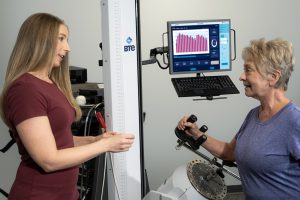
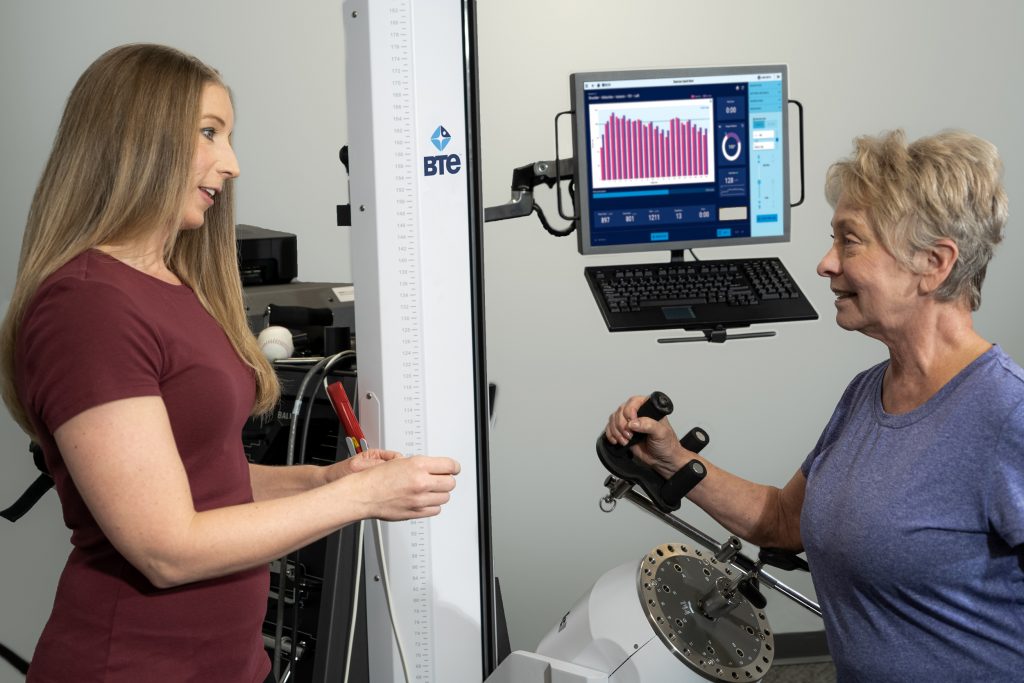
Consider implementing weekly team meetings where all disciplines review complex cases together. Use standardized assessment tools across departments to create a common language for discussing patient progress. Systems like the PrimusRS can help your team objectively measure and track functional improvements across multiple joints and functional activities, providing the quantified data that supports interdisciplinary discussions and treatment planning.
Early and Intensive Intervention: Balancing Urgency with Evidence
Research consistently shows that early mobilization after stroke improves outcomes, but the AVERT trial taught us an important lesson: timing and intensity matter. Starting rehabilitation as soon as a patient is medically stable is crucial, but we need objective measures to determine the right intensity for each individual.
This is where your clinical judgment meets operational strategy. By using objective assessment tools from day one, you can:
- Document baseline function with precision
- Justify the level of care intensity to insurers
- Track incremental improvements that might be missed by observation alone
- Adjust treatment intensity based on measurable progress markers
For clinicians, this means having confidence that your treatment decisions are data-driven. For administrators, it means having the documentation to support your care model when negotiating with payers or demonstrating value to hospital partners.
Evidence-Based Strategies & Objective Measurement
The Cornerstone: Individualized Assessment as a Strategic Tool
Here’s a critical insight from the field: there’s currently no single functional assessment used consistently throughout the entire stroke care continuum. This gap creates problems for everyone. Clinicians struggle to track progress across settings, administrators can’t easily aggregate outcome data, and patients receive fragmented feedback about their recovery.
Your opportunity lies in standardizing objective assessment across your program. When you use validated measures like the Fugl-Meyer Assessment alongside technology-based objective testing, you create a powerful combination. The validated scales provide the clinical framework, while tools like PrimusRS deliver the granular, objective data that brings those frameworks to life.
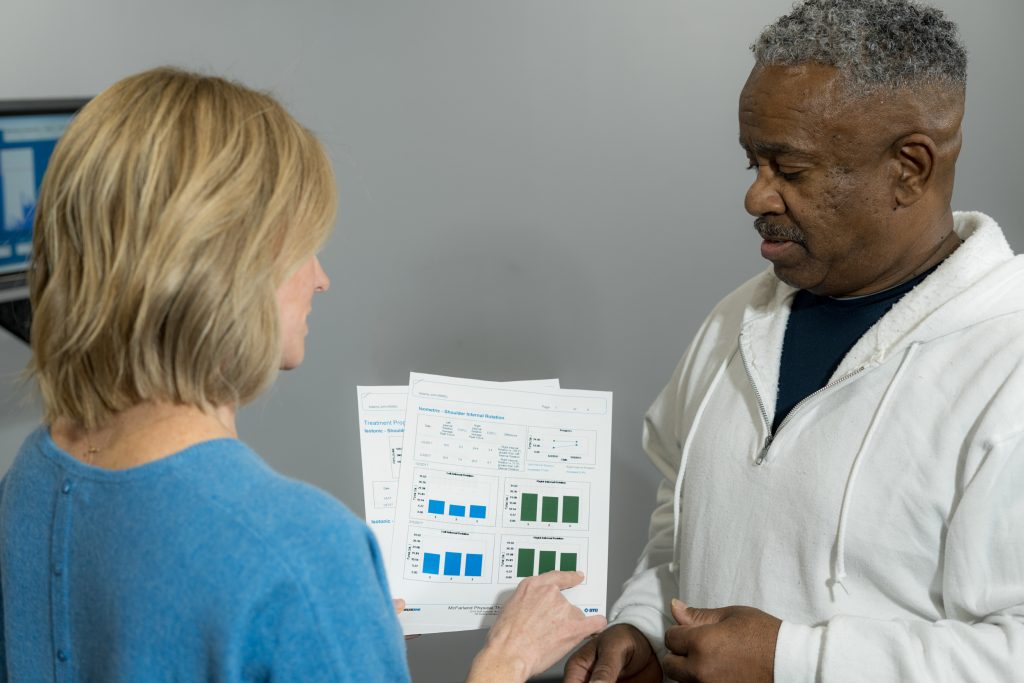
For clinicians, this approach enables you to create truly individualized treatment plans based on specific strength deficits, range of motion limitations, and functional capacities. You’re not just noting that a patient has “moderate weakness”; you’re documenting that their shoulder flexion strength is 15 pounds at 90 degrees, providing a clear baseline and measurable treatment target.
For owners and administrators, standardized objective assessment becomes your quality assurance system. It enables you to:
- Generate powerful outcome reports for marketing and referral development
- Provide clear progress documentation for reimbursement
- Create internal benchmarks for program effectiveness
- Train new staff more efficiently with standardized protocols
Activating Neuroplasticity: From Motor Learning Theories to Measurable Progress
The beauty of modern stroke rehabilitation lies in our understanding of neuroplasticity. We know the brain can reorganize and form new connections, but activating this potential requires the right approach. Let’s translate key therapeutic strategies into practical, measurable interventions.
Constraint-Induced Movement Therapy (CIMT) works by forcing use of the affected limb, but success depends on tracking incremental improvements in strength and control. Our product, the Simulator II allows clinicians to replicate functional tasks while capturing objective data on force production, speed, and accuracy, making CIMT progress visible and motivating for patients.
Task-Specific Training emphasizes practicing real-world movements, but without objective measurement, it’s difficult to optimize difficulty progression. When you incorporate tools like PrimusRS that provide real-time feedback on performance metrics, patients can see their improvements in real-time, increasing engagement and adherence.
Trunk Restraint Approaches for upper extremity training become more effective when you can objectively measure how restraining compensatory movements improves distal control. Technology that provides instant feedback helps patients understand the connection between proximal stability and distal function.
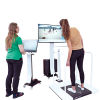
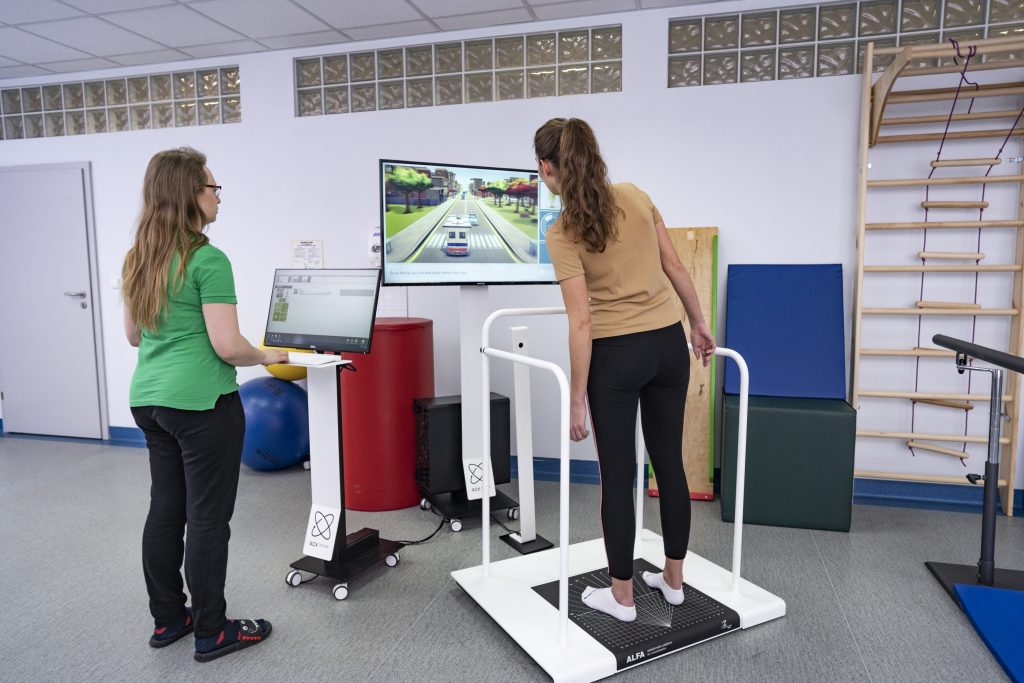
For Balance and Postural Control, systems like Alfa transform traditional balance training into engaging, measurable interventions. Clinicians can track weight distribution, sway patterns, and reaction times, providing objective markers of progress that traditional observation might miss.
Leveraging Technology to Elevate Care and Efficiency
The Tech-Enabled Therapist: Integrating Modern Tools for Better Outcomes
Technology in stroke rehabilitation isn’t about replacing clinical expertise; it’s about amplifying your capabilities. When you integrate the right tools, several transformations occur in your practice.
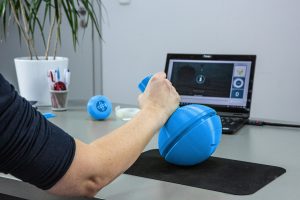
Virtual reality and gamification turn repetitive exercises into engaging challenges. Our Capri system, for instance, helps clinicians provide intensive hand therapy through gamified exercises that maintain patient engagement while capturing detailed performance metrics. This combination of engagement and measurement is particularly valuable for stroke patients who need high repetition numbers to drive neuroplastic change.
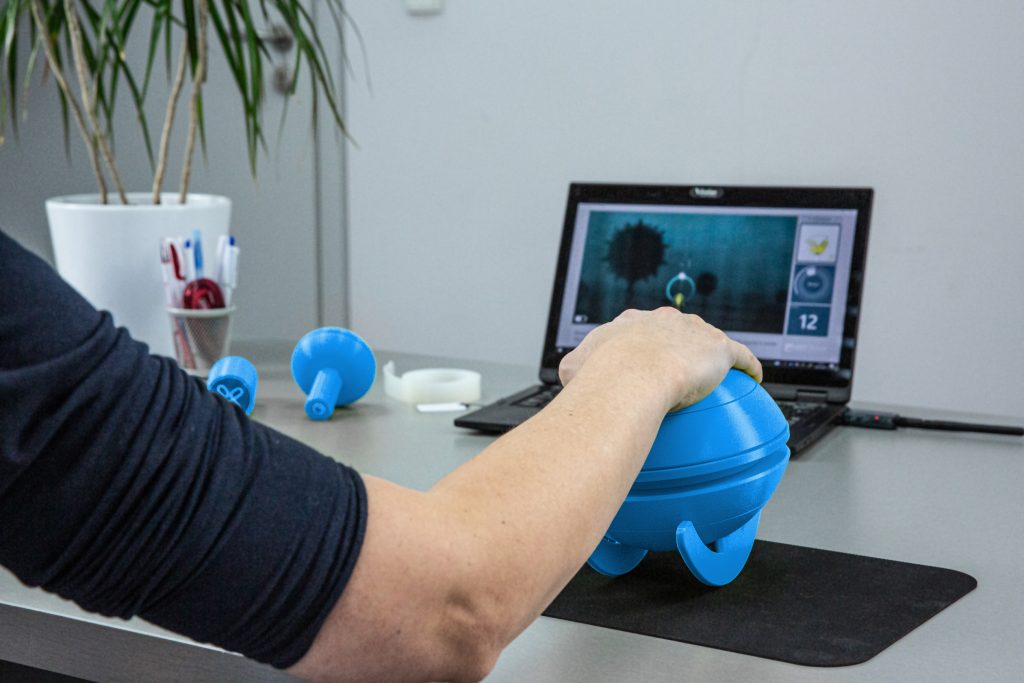
Robotic-assisted therapy and motorized resistance systems allow you to provide consistent, graded resistance that would be difficult to achieve manually. The Eccentron enables clinicians to deliver eccentric training for lower extremities, which research shows requires less oxygen consumption and reduces fatigue while allowing higher loading capacity, perfect for stroke patients with limited endurance.
Telerehabilitation capabilities extend your reach beyond clinic walls, ensuring continuity of care and increasing access for patients with transportation challenges. When combined with objective assessment tools, telerehab sessions become as measurable and accountable as in-person visits.
The Power of Data: Using Objective Metrics to Guide Treatment and Prove Outcomes
This is where your stroke rehabilitation program transforms from good to exceptional. Objective data doesn’t just document progress; it drives clinical decisions, engages patients, and proves value to stakeholders.
For clinicians, having access to precise strength measurements, range of motion data, and functional capacity metrics means you can:
- Identify subtle improvements that motivate patients during challenging plateaus
- Adjust treatment parameters based on objective response to intervention
- Communicate more effectively with physicians and other team members using quantified language
For clinic owners and administrators, this data becomes your competitive advantage. You can demonstrate to referral sources that your program doesn’t just provide therapy; it delivers measurable, trackable improvements. Insurance companies receive documentation that clearly justifies continued treatment. Marketing materials can showcase real outcome statistics, not just testimonials.
Managing All Phases of Care
Proactive Management: Addressing Comorbidities and Secondary Prevention
Successful stroke rehabilitation extends beyond motor recovery. Your program needs to address the full spectrum of potential complications while maintaining focus on functional goals. This comprehensive approach reduces readmissions, improves overall outcomes, and positions your program as truly comprehensive.
Managing DVT risk, preventing contractures, addressing post-stroke depression, and monitoring for shoulder subluxation all require systematic approaches backed by objective monitoring. When you can document not just that you’re addressing these issues, but show measurable indicators of successful prevention, you demonstrate the full value of your program.
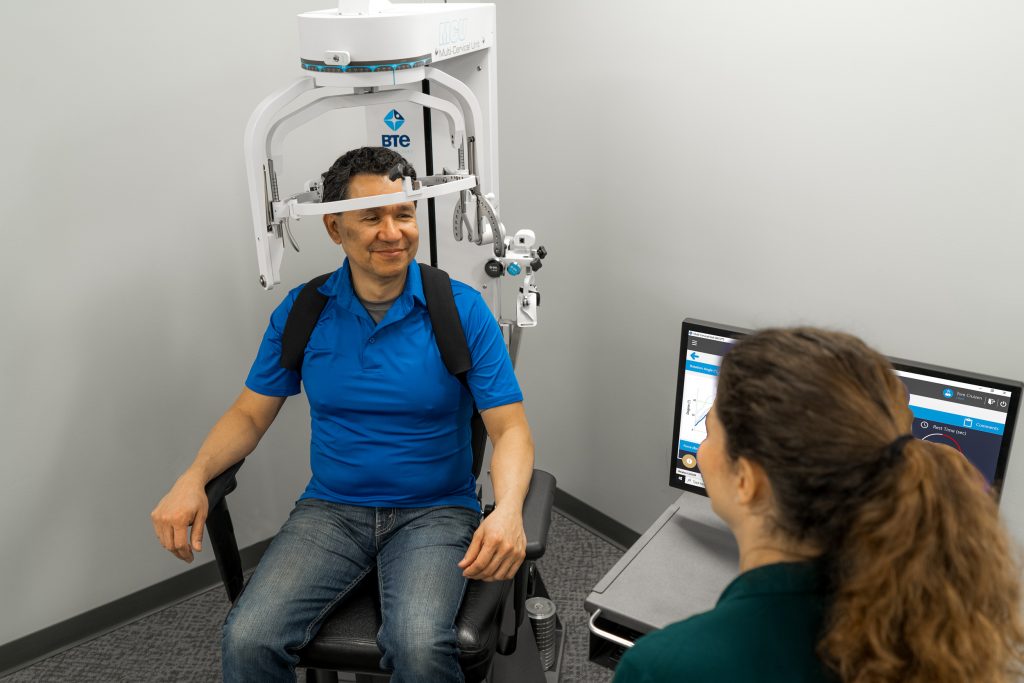
For administrators, this proactive management translates directly to quality metrics and reduced liability. For clinicians, it means having clear protocols and objective markers that guide decision-making. The Multi-Cervical Unit (MCU) exemplifies this approach for cervical spine complications, allowing clinicians to objectively assess and strengthen cervical musculature often affected by stroke, with controlled positioning and measurable outcomes.
From Clinic to Community: Ensuring Lasting Success
The ultimate goal of stroke rehabilitation isn’t just recovery; it’s successful community reintegration. This requires thinking beyond traditional therapy metrics to consider real-world function, caregiver capability, and long-term management strategies.
Patient and caregiver education becomes more effective when supported by objective progress reports. Instead of telling a family member that their loved one is “getting stronger,” you can show them graphs demonstrating improved force production, increased range of motion, or enhanced balance control. This concrete feedback helps set realistic expectations and improves adherence to home programs.
For clinic owners, community reintegration programs represent opportunities for service expansion. Consider developing wellness programs for stroke survivors, caregiver training workshops, or return-to-work preparation services. These programs not only generate additional revenue but build long-term relationships that enhance your reputation and referral network.
Your Strategic Checklist for a Future-Ready Stroke Rehab Program
Clinical excellence and operational success work hand in hand. As you evaluate your stroke rehabilitation program, consider these critical questions:
For Clinic Owners and Administrators:
- Are you using standardized, objective assessment tools that create consistent data from initial evaluation through discharge?
- Can you generate outcome reports that clearly demonstrate value to referral sources and payers?
- Have you created efficient workflows that maximize therapist productivity without sacrificing quality?
For Clinical Practitioners:
- Can you objectively quantify changes in motor control, not just functional performance?
- Are you using technology to increase treatment intensity while managing multiple patients effectively?
- Do your documentation and progress notes include specific, measurable data points that support clinical decisions?
Moving Forward with Confidence
Building a world-class stroke rehabilitation program requires more than clinical knowledge. It demands the integration of evidence-based protocols with operational excellence, objective measurement, and strategic thinking. When you combine interdisciplinary coordination, early intervention, task-specific training, and technology-enabled assessment, you create a program that delivers exceptional outcomes for patients while building a stronger, more sustainable practice.
The tools and strategies discussed here aren’t just theoretical concepts; they’re practical approaches being implemented in successful programs across the country. By focusing on objective measurement, standardized protocols, and data-driven decision-making, you position your program to thrive in an increasingly competitive and outcome-focused healthcare environment.
Ready to transform your stroke rehabilitation program with objective assessment and measurement tools?
Discover how BTE’s comprehensive product line provides the technology and support needed to implement these best practices effectively. From initial evaluation through return to work, BTE helps clinicians deliver measurable results that benefit patients, satisfy payers, and strengthen your program’s reputation.
FAQ’s about Stroke Rehabilitation for PT & OT Clinics
How soon after a stroke should rehabilitation begin, and what are the key considerations for early intervention?
Rehabilitation should ideally begin within 24-48 hours post-stroke, once the patient is medically stable. Early intervention is critical because it capitalizes on neuroplasticity when the brain’s ability to reorganize is at its peak. Key considerations include: assessing the patient’s medical stability and contraindications, preventing secondary complications like contractures and muscle atrophy, establishing baseline functional assessments, and coordinating with the medical team. Even bedside activities like passive range of motion, positioning, and basic cognitive stimulation can begin immediately. Early mobilization has been shown to reduce hospital length of stay and improve long-term functional outcomes.
What assessment tools should we use to evaluate stroke patients and how often should we reassess progress?
Essential assessment tools include the Fugl-Meyer Assessment for motor function, the Berg Balance Scale for balance and fall risk, the Functional Independence Measure (FIM) for daily living skills, and the Montreal Cognitive Assessment (MoCA) for cognitive function. Initial comprehensive assessments should occur within 72 hours of admission, with focused reassessments weekly during acute care and every 2-4 weeks in outpatient settings. Document specific impairments like hemiplegia, aphasia, neglect, and dysphagia. Regular reassessment allows for treatment plan modifications, demonstrates progress to insurance providers, and helps determine appropriate discharge planning and equipment needs.
How do we determine which motor recovery approach to use – Brunnstrom, Bobath, or task-specific training?
The choice depends on the patient’s recovery stage, tone patterns, and functional goals. Use Brunnstrom approach for patients in early recovery stages (1-3) who need to progress through synergistic movement patterns before achieving selective movement. Apply Bobath techniques for patients with abnormal tone, spasticity, or primitive reflexes to normalize movement patterns and improve postural control. Implement task-specific training for higher-functioning patients (Brunnstrom stages 4-6) who can benefit from practicing real-world activities. Often, a combination approach works best – start with tone normalization techniques, progress through movement patterns, then advance to functional task practice. Always consider the patient’s cognitive status and motivation level when selecting approaches.
What are the contraindications and safety precautions we need to follow during stroke rehabilitation?
Key contraindications include unstable vital signs, active cardiac issues, severe orthostatic hypotension, and acute medical complications. Safety precautions require monitoring blood pressure before, during, and after therapy (hold therapy if systolic >200 or diastolic >110), implementing fall prevention strategies including gait belts and appropriate supervision levels, being alert for signs of fatigue or overexertion, and maintaining aspiration precautions if dysphagia is present. Always have emergency procedures readily available, ensure proper body mechanics during transfers, use appropriate assistive devices, and coordinate with nursing regarding medication timing that might affect therapy performance. Document any adverse events immediately and communicate with the medical team.
How should we modify treatment approaches for patients with cognitive deficits, neglect, or aphasia?
For cognitive deficits, break tasks into simple steps, use repetition and consistent cueing, provide adequate processing time, and minimize distractions in the treatment environment. For spatial neglect, position yourself and materials on the affected side, use verbal and visual cues to direct attention leftward, incorporate scanning activities, and gradually fade prompts as awareness improves. With aphasia patients, use simple language, visual demonstrations, gestures, and written instructions when appropriate. Allow extra time for responses, confirm understanding through demonstration rather than verbal confirmation, and coordinate closely with speech therapy. Always treat these patients with dignity and avoid talking about them as if they’re not present. Consider fatigue levels as cognitive processing requires significant energy post-stroke.
What documentation and insurance considerations are essential for stroke rehabilitation services?
Documentation must demonstrate medical necessity by clearly linking interventions to specific functional deficits and measurable goals. Include objective measurements using standardized assessments, document progress toward functional outcomes rather than just impairment-level changes, and specify skilled intervention techniques that require professional expertise. For Medicare patients, ensure compliance with the therapy cap exceptions and document complexity factors that justify continued skilled care. Address discharge planning early, including home safety assessments and caregiver training needs. Insurance often requires prior authorization for certain equipment or extended therapy services, so initiate these requests promptly. Maintain clear communication with case managers and document any barriers to progress such as medical complications, cognitive limitations, or psychosocial factors that impact rehabilitation potential.