
Learn what BFR training is, how blood flow restriction works, and why it builds muscle with lighter weights by leveraging metabolic stress and fast-twitch fiber recruitment.
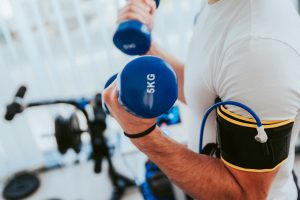
Blood Flow Restriction (BFR) uses cuffs or bands to partially restrict venous return from working muscles while maintaining arterial inflow. By creating a low-oxygen, high-metabolite environment, BFR enables meaningful strength and hypertrophy adaptations using lighter loads than traditional training. It is used by rehab clinicians, strength coaches, and athletes to build muscle while minimizing joint stress or post-operative load on healing tissues.
BFR Definition and Alternative Names
BFR stands for “Blood Flow Restriction,” a method that limits venous outflow and preserves arterial inflow during exercise, promoting strong metabolic and neural stimuli for adaptation.
This method is referred to by several names:
| Term/Name | Origin/Context | Usage Notes |
| Blood Flow Restriction (BFR) | Scientific/medical literature | Most common term in research and clinical settings |
| KAATSU Training | Japan (original method) | Traditional name from the technique’s development |
| Occlusion Training | General fitness industry | Widely used in strength and conditioning |
| Vascular Occlusion Training | Clinical rehabilitation | Often used in PT/OT contexts |
Originating with KAATSU in Japan in the 1960s, BFR can drive muscle growth and strength using ~20–40% 1RM, versus the ~70–85% 1RM typically required in conventional hypertrophy protocols.
Physiological Mechanisms Behind BFR Training
BFR heightens metabolic stress, cellular swelling, and fast-twitch recruitment with light loads, activating pathways similar to heavy lifting.
| Physiological Process | What Happens | Training Benefit |
| Metabolite Accumulation | Lactate/H⁺ build up in muscle | Amplifies afferent signaling and anabolic cascades |
| Hypoxic Environment | Lower intramuscular O₂ | Enhances growth-factor signaling and adaptation |
| Motor Unit Recruitment | Early Type II fiber involvement | Strength/power gains at low external loads |
| mTORC1/Protein Synthesis | Anabolic signaling increases | Drives muscle protein synthesis and hypertrophy |
| Cellular Swelling | Intracellular fluid shifts | Hypertrophy stimulus via mechanotransduction |

BFR Equipment Types and Application Methods
Effective, safe BFR depends on appropriate equipment, individualized pressure, and correct placement.
Equipment Types
| Equipment Type | Pressure Control | Accuracy | Cost Range | Best For |
| Pneumatic Cuffs | Automated/programmable pressure (mmHg) | High (± ~5 mmHg) | Higher | Clinical settings, research, serious athletes |
| Elastic Bands | Manual tightening (perceived tightness) | Moderate (user-dependent) | Lower | General fitness, home use with guidance |
Pneumatic systems provide measured, reproducible pressures—ideal for clinics and high-control settings. Elastic bands are accessible but require coaching to avoid over-tightening.
Pressure Settings and Placement
- Individualize by Limb Occlusion Pressure (LOP): Determine LOP (the minimum pressure that fully occludes arterial flow). Train at a fraction of LOP to maintain arterial inflow.
- Upper limb: ~40–50% LOP
- Lower limb: ~60–80% LOP
- Upper limb: ~40–50% LOP
- Cuff width matters: Wider cuffs need lower pressure; narrower cuffs require higher pressure to achieve the same effect.
- Placement: Position cuffs proximally on the limb (upper arm or upper thigh), never across joints or bony prominences.
- Safety checks: Confirm distal pulse/sensation, normal color, and rapid capillary refill. Stop if numbness, tingling, sharp pain, or unusual discoloration occur.
Safety Contraindications
Screen for risks and follow stop-criteria. Examples:
| Contraindication | Risk Level | Reason | Alternative Recommendation |
| Active or recent DVT/PE, known clotting disorders | Absolute | Elevated thrombosis risk | Standard resistance training under medical guidance |
| Severe peripheral arterial disease or uncontrolled hypertension | Absolute | Vascular/pressure complications | Medically supervised alternatives |
| Pregnancy | Absolute | Insufficient safety data | Prenatal-appropriate exercise |
| Active infection, open wounds at cuff site | Absolute | Complication risk | Treat/resolve before training |
| Recent surgery (early post-op) without clearance | Relative | Healing and tissue stress | Wait for physician/therapist clearance |
| Cardiac disease, diabetes with neuropathy, sickle-cell trait, varicosities/lymphedema | Relative | Potential vascular/nerve complications | Case-by-case with clinician supervision |
Stop-criteria: Marked limb pain, numbness/tingling, pallor/cyanosis, dizziness, or unusual shortness of breath—deflate immediately and reassess.
Training Protocols
BFR programming differs from traditional lifting and prioritizes metabolic stress with low loads.
| Training Variable | Recommended Range | Beginner Recommendation | Notes/Considerations |
| Pressure Setting | 40–80% LOP (limb- and cuff-specific) | 40–50% LOP | Start conservative; progress with tolerance |
| Rep Scheme | 30-15-15-15 | 30-15-15-15 | 30–60 s rests; keep cuff inflated through set clusters |
| Training Frequency | 2–4 sessions/week | 2 sessions/week | Ensure recovery; monitor soreness |
| Load Intensity | ~20–40% 1RM | ~20–30% 1RM | Emphasize controlled tempo and full ROM |
| Session Duration | ~15–20 minutes | ~10–15 minutes | Include time for LOP assessment and setup |
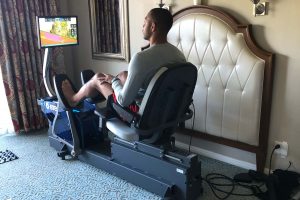
Variations include walking/cycling with BFR in early rehab or deconditioned populations, and accessory lifts with BFR to add volume without heavy joint loading.
Final Thoughts
BFR is a research-supported way to gain strength and size using light loads, useful for rehab phases, joint-sparing programs, and performance plateaus. Results hinge on measured pressure (LOP-based), proper cuff selection/placement, and clear safety protocols. For clinical and performance settings, BTE Technologies supports evidence-based workflows—combining objective assessment, staff training, and standardized protocols to deliver safe, effective BFR integration.