Berg Balance Scale Score Interpretation Guide for Rehab Therapists
Treatment Guidelines
Learn about the Berg Balance Scale (BBS), a clinical assessment tool with 14 functional balance tasks that evaluate fall risk and balance problems in adults.
The Berg Balance Scale (BBS) is a clinical assessment tool with 14 functional balance tasks that evaluate fall risk and balance problems in adults. This standardized assessment gives healthcare professionals a reliable method to measure static and dynamic balance abilities, making it essential for patient safety evaluation and treatment planning.
Rehab therapists working in geriatrics or neurological care need to understand the Berg Balance Scale because it directly affects patient safety decisions and treatment outcomes. In stroke rehab, for example, incorporating balance assessments for stroke rehabilitation is a best practice for reducing fall risk and optimizing patient progress.
What The Berg Balance Scale Measures
Katherine Berg developed the Berg Balance Scale as a complete tool for assessing static and dynamic balance abilities in clinical populations. This assessment is a common clinical balance evaluation because it works very well across different patient groups.
The BBS primarily assesses fall risk and monitors balance improvements over time. Key benefits of this assessment include:
- Multiple clinical uses – Applied across populations, including elderly patients, stroke survivors, and individuals with neurological conditions. For clinic managers looking to implement stroke rehabilitation best practices, the BBS is a foundational tool for ongoing balance assessment.
- Quick administration – Takes 15-20 minutes to complete with minimal equipment required
- Real-world focus – Evaluates balance tasks that patients encounter in daily activities
- Consistent protocol – Provides uniform measurement criteria for reliable results across different clinicians and settings
- Research-backed – Extensively studied and validated for clinical decision-making
The assessment works well for initial evaluations, progress monitoring, and discharge planning in various rehab settings.

The 14 Tasks and What They Indicate About Balance
The Berg Balance Scale consists of 14 specific functional tasks that progress from basic stability requirements to more challenging dynamic movements. Each task is scored using a 0-4 point system, generating a total possible score of 56 points.
The following table provides a comprehensive overview of all 14 test items and their key characteristics:
| Item | Test Item/Task Description | Equipment Needed | Scoring Criteria Overview |
|---|---|---|---|
| 1 | Sitting to Standing | Standard chair | 0: Unable to stand;
4: Stands independently |
| 2 | Standing Unsupported | None | 0: Unable to stand;
4: Stands safely 2 minutes |
| 3 | Sitting Unsupported | Chair | 0: Unable to sit;
4: Sits safely 2 minutes |
| 4 | Standing to Sitting | Chair | 0: Needs assistance;
4: Sits safely with minimal hand use |
| 5 | Transfers | Two chairs | 0: Needs assistance;
4: Transfers safely independently |
| 6 | Standing with Eyes Closed | None | 0: Needs help to avoid falling;
4: Stands safely 10 seconds |
| 7 | Standing with Feet Together | None | 0: Needs help to attain position;
4: Stands independently 1 minute |
| 8 | Reaching Forward with Outstretched Arm | Ruler | 0: Loses balance;
4: Reaches forward >25cm safely |
| 9 | Retrieving Object from Floor | Small object | 0: Unable/unsafe;
4: Picks up object safely |
| 10 | Turning to Look Behind | None | 0: Needs supervision;
4: Turns safely both directions |
| 11 | Turning 360 Degrees | None | 0: Needs assistance;
4: Turns safely in <4 seconds |
| 12 | Placing Alternate Foot on Stool | Step/stool | 0: Needs assistance;
4: Completes 8 steps in 20 seconds |
| 13 | Standing with One Foot in Front | None | 0: Cannot place foot;
4: Holds position 30 seconds |
| 14 | Standing on One Foot | None | 0: Cannot lift foot;
4: Lifts foot independently 10 seconds |
How to Score Each Task
Each item is scored from 4 to 0 points, based on the patient’s ability to perform the task safely and independently. A higher score means the patient completed the task safely, independently, and within normal parameters. Each of the 14 tasks has a specific scoring criteria.
For example, scoring the task “reaching forward with outstretched arm” follows this criteria:
- 4 points – Can reach forward confidently 10 inches (25 cm)
- 3 points – Can reach forward 5 inches (12 cm)
- 2 points – Can reach forward 2 inches (5 cm)
- 1 point – Reaches forward, but needs supervision
- 0 points – Loses balance while trying or requires external support
This detailed scoring rubric breaks down the criteria for each task on the Berg Balance Scale.
How to Interpret BBS Scores (and What They Mean for Fall Risk)
Berg Balance Scale scores provide critical information for determining fall risk levels and guiding clinical decisions. The total score directly relates to patient safety and the need for interventions or environmental modifications.
The following table outlines the standard score interpretation framework:
| Score Range | Fall Risk Level | Clinical Interpretation | Recommended Actions |
|---|---|---|---|
| 45-56 | Low Risk | Good balance function with minimal fall risk | Routine monitoring, general safety education |
| 21-44 | Moderate Risk | Increased fall risk requiring intervention | Balance training, environmental modifications, assistive devices |
| 0-20 | High Risk | Significant fall risk with safety concerns | Immediate intervention, close supervision, comprehensive fall prevention |
How BBS Scores Drive Treatment Decisions
Scores below 45 indicate increased fall risk requiring active intervention and safety planning. The assessment provides valuable information for:
- Treatment planning – Identifying specific balance deficits to target in therapy
- Safety recommendations – Determining need for assistive devices or environmental modifications
- Progress monitoring – Tracking improvements or declines in balance function over time
- Discharge planning – Assessing readiness for independent living or need for continued care
The minimal detectable change varies by score range, with greater sensitivity to change in moderate score ranges. Clinicians should consider BBS results alongside other assessment measures for complete evaluation and treatment planning.
Using the Berg Balance Scale with other functional assessments provides a more complete picture of patient capabilities and safety considerations for optimal care coordination. Those with a higher fall risk may benefit from neuromuscular reeducation techniques to help improve coordination.
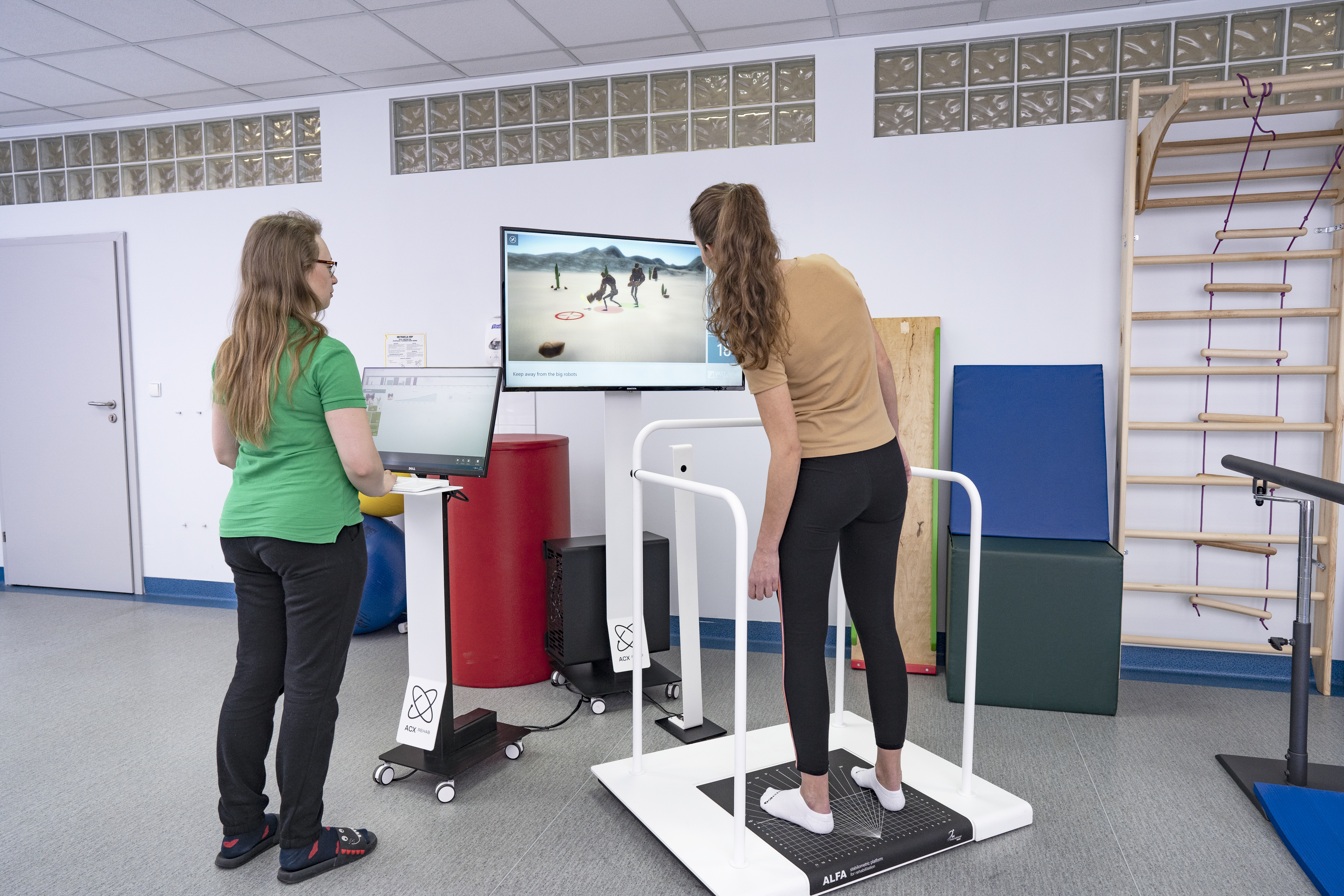
Used alongside the Berg Balance Scale, interactive balance systems help translate observational scoring into active rehabilitation. A good example is one of our (BTE) physical therapy equipment, the Alfa, a balance assessment and training device with therapeutic gaming. Alfa targets the same balance components assessed in the Berg: static and dynamic stability, weight shifting, and postural control, while providing therapeutic gaming that keeps patients engaged to support long-term balance improvement.
Conclusion
The Berg Balance Scale is a decision-making tool that helps quantify fall risk and guide treatment direction. When paired with tools that move beyond observation into objective measurement and training, it becomes part of a more complete, data-driven approach to balance rehabilitation.
When paired with modern rehabilitation technologies that address the same functional components—such as postural control, weight shifting, and stability—the Berg Balance Scale can play a central role in a more complete, data-informed approach to balance assessment and intervention.