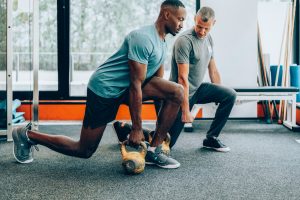
Isometric testing options, from manual muscle testing to advanced dynamometers. Highlighting differences in accuracy, cost, and clinical applications.
For a detailed comparison of isometric, isotonic, and isokinetic muscle actions and how these concepts relate to different testing and rehabilitation strategies, explore our guide on Isokinetic vs Isotonic vs Isometric.
How Isometric Testing Measures Static Muscle Strength
Many clinics perform isometric testing daily. Fewer can clearly explain how those numbers alter exercise progression, load management decisions, or discharge criteria. Overlooked variables like positioning, stabilization, or pain can influence the number you capture. When those variables are controlled and data is applied with functional goals in mind, isometric testing shifts from a routine checkbox to a meaningful decision-making tool.
Isometric testing evaluates the body’s ability to produce force during static muscle contractions. The muscle generates tension without shortening or lengthening. Unlike dynamic testing that involves movement through a range of motion, isometric assessments capture strength at specific joint angles and positions.
Maximum Force Production Without Movement
Isometric testing measures maximum voluntary isometric contraction (MVIC), which represents the highest force a muscle or muscle group can generate at a specific joint position. During these contractions, muscle fibers activate and create tension against an immovable resistance, allowing for precise force measurement without the variables introduced by joint movement.
For details on MVIC testing and accurate strength evaluation, see our guide on strength testing, manual muscle testing, and dynamometry.
Key Terms for Understanding Isometric Test Results
Understanding key terms is crucial for interpreting isometric test results and methodology:
| Term | Definition | Context/Usage | Related Concepts |
| MVIC (Maximum Voluntary Isometric Contraction) | The highest force output achieved during a static muscle contraction | Used as the gold standard for strength assessment | Peak force, force production |
| Peak Force | The maximum force value recorded during an isometric contraction | Measured in pounds, kilograms, or Newtons | MVIC, force output |
| Static Contraction | Muscle activation without joint movement or muscle length change | Distinguishes isometric from dynamic contractions | Isometric hold, muscle tension |
| Force Production | The ability of muscles to generate measurable force output | Central concept in strength assessment | Muscle activation, neuromuscular function |
| Muscle Activation | The recruitment and firing of motor units during contraction | Indicates neuromuscular system efficiency | EMG activity, force generation |
Different Contraction Types for Specific Assessments
Isometric testing includes several contraction types, each serving specific assessment purposes. Submaximal isometric contractions evaluate endurance and control at predetermined force levels, while maximal contractions determine peak strength capacity. Functional isometric positions test strength in sport-specific, exercise or daily activity postures, providing practical strength assessments relevant to real-world performance.
Equipment Options from Basic to Advanced Systems
Various isometric testing methods exist, each using different equipment and offering distinct advantages. The key difference isn’t just cost or complexity, it’s the level of control, repeatability, and ease of documentation each option provides. From manual resistance and handheld dynamometers to fixed-frame digital sstems, the equipment you choose directly impacts the reliability of your data.
PrimusRS: Equipment Pro Tips for Isometric Testing
BTE offers physical therapy equipment for precise isometric strength assessment:
PrimusRS
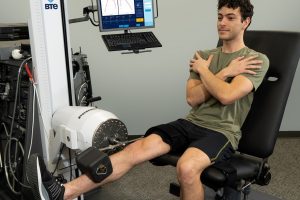
Use PrimusRS for highly controlled, joint-specific isometric testing of the upper or lower extremities—lock in the test angle, stabilize the patient, and record at least two MVIC trials for reliable baselines and side-to-side comparisons.
We recommend standardizing your setup (seat height, lever arm, joint angle), providing consistent verbal cues, and exporting the data to clearly demonstrate pre/post changes for return-to-play, post-op milestones, or work-hardening documentation.
Comparing Testing Methods and Equipment
The following table provides a comprehensive comparison of available isometric testing options to help determine the most suitable method for specific needs:
| Testing Method | Equipment Required | Accuracy Level | Cost Range | Best Use Cases | Advantages | Limitations |
| Manual Muscle Testing (MMT) | Examiner’s hands, standardized positions | Low to Moderate | Minimal | Clinical screening, bedside assessment | No equipment needed, quick assessment | Subjective, limited precision |
| Handheld Dynamometry | Handheld dynamometer device | Moderate to High | Low to Moderate | Clinical practice, field testing | Portable, objective measurements | Examiner strength limitations |
| Isokinetic Dynamometers | Computer-controlled isokinetic machine | High | High | Research, advanced clinical assessment | Precise control, comprehensive data | Expensive, requires training |
| Force Platforms | Force plate systems with software | Very High | High | Research, biomechanics labs | Multi-directional force measurement | Limited to specific positions |
| Functional Isometric Positions | Varies by test setup | Moderate | Variable | Sport-specific assessment | Task-specific evaluation | Setup complexity varies |

Manual Testing Using Examiner Resistance
Manual muscle testing represents the most basic form of isometric assessment, relying on the examiner’s hands to provide resistance while the patient maintains a static contraction. This method uses standardized positions and grading scales to evaluate muscle strength across different muscle groups. While manual testing is widely used, pairing it with objective tools such as handheld dynamometers can further enhance clinical accuracy.
Portable Devices for Objective Measurements
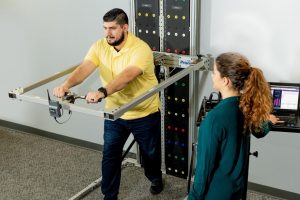
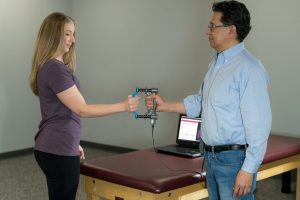
Handheld dynamometers provide objective force measurements while maintaining portability and convenience. These devices offer quantifiable results that eliminate the subjectivity inherent in manual muscle testing. Portable testing tools like EVJ and Evaluator allow clinicians to perform objective functional assessments at any location with consistency and precision.
Advanced Systems for Research Applications
Isokinetic dynamometers and force platforms represent the most sophisticated isometric testing equipment, providing precise measurements and comprehensive data analysis capabilities. These systems offer comprehensive testing protocols and detailed reporting features for research applications and advanced clinical assessments.
Clinical Applications Across Populations
Isometric testing offers numerous advantages across clinical, athletic, and research settings, making it a versatile assessment tool for various populations and purposes. The safety profile and efficiency of isometric testing make it particularly valuable for specific applications where dynamic testing may be inappropriate or impractical.
Professional Uses Across Different Patient Populations
Isometric testing serves diverse applications across multiple professional contexts:
| Application Field | Target Population | Primary Benefits | Typical Measurements | Example Scenarios |
| Injury Rehabilitation | Patients recovering from injury | Safe strength assessment, progress monitoring | MVIC, force deficits | Post-ACL surgery, rotator cuff repair |
| Athletic Performance | Athletes, sports teams | Baseline strength, return-to-play decisions | Peak force, bilateral comparisons | Pre-season screening, injury prevention |
| Pre/Post-Surgical Evaluation | Surgical candidates and patients | Objective strength documentation | Strength ratios, functional capacity | Joint replacement, ligament reconstruction |
| Elderly Population Screening | Older adults, fall risk assessment | Safe testing method, functional evaluation | Grip strength, lower extremity strength | Balance programs, falls prevention |
| Research Studies | Various research populations | Standardized measurements, data collection | Force-time curves, muscle activation | Intervention studies, normative data |
Primary Benefits for Practitioners and Patients
Safety for Injured Populations: Isometric testing eliminates the risk associated with joint movement through painful or unstable ranges of motion, making it ideal for acute injury assessment and early rehabilitation phases.
Time Efficiency: Most isometric tests can be completed quickly, requiring only brief maximal contractions rather than extended movement patterns, making them practical for busy clinical environments.
Objective Measurement: Unlike subjective assessment methods, objective isometric testing provides quantifiable data that can be tracked over time, enabling precise monitoring of strength changes and treatment effectiveness.
Versatility: Isometric testing can be applied to virtually many muscle groups, allowing for comprehensive strength evaluation across different body regions and functional positions.
Practical Tips for Better Isometric Testing
Even minor inconsistencies can skew strength data. Consider these small adjustments adjustments:
-
Standardize joint angle and seat position. Even a few degrees of variation can alter force output.
-
Control external stabilization. Ensure trunk and proximal segments are supported to isolate the target muscle group.
-
Provide consistent verbal encouragement. Research shows verbal cueing significantly affects MVIC performance.
-
Record at least two to three trials. Single attempts often underestimate true maximal output.
-
Document pain levels during testing. Pain inhibition can reduce force production and misrepresent capacity.
Conclusion: The Value of Isometric Strength Testing
Isometric testing remains one of the most practical, safe, and adaptable tools available for assessing strength across clinical populations. Its ability to quantify force without joint movement makes it especially valuable in early rehabilitation and high-irritability presentations, while its versatility supports applications from orthopedic recovery to performance benchmarking.
But the true value of isometric testing isn’t in the act of measuring—it’s in the rigor behind the measurement and the decisions that follow. When variables are controlled, protocols are standardized, and thresholds for progression are defined, strength data becomes more than documentation. It becomes direction. By approaching isometric testing with intentionality rather than routine, clinicians can transform a familiar assessment into a precise, defensible, and clinically meaningful component of patient care.