Knee Osteoarthritis Rehabilitation: The Quad Deficits You're Not Measuring
Treatment Guidelines
If there is one finding rehab research agrees on in knee osteoarthritis, it is this: quadriceps weakness is among the most consistent drivers of OA-related pain and function loss. It predicts who develops the disease, who progresses, and who ends up needing a joint replacement.
So most programs set out to “strengthen the quad.” The problem is how weakness gets measured — usually a manual muscle test, or at best a single peak-strength number. And that is where good rehab quietly leaves results on the table.
This article makes the case for measuring a comprehensive strength profile, not just peak strength. We will cover why the quad deficit matters so much, the four muscle performance measures that give you the full picture of function, how the profile drives the right dose of loading, and how it all fits into a phased program you can document.
Quad Weakness Is the Through-Line in Knee OA
The evidence here is unusually strong, and it is worth stating plainly for patients, referrers, and payers alike:
- Knee extensor weakness is a risk factor for developing knee OA — not just a consequence of it.1
- Weakness predicts both radiographic and symptomatic OA, and can be present even before pain appears.2
- Quadriceps strength predicts knee-replacement risk independent of radiographic disease severity and pain.3
Strength is also the main factor associated with physical performance in older adults with knee OA, regardless of how the joint looks on imaging. In other words, the muscle, not just the cartilage, is where a lot of the disability lives — and the muscle is the part you can actually change.

But “Weakness” Isn’t One Number — It’s a Profile
Here is the gap most protocols miss. Muscle performance is not a single quantity. A quad can fail a patient in several distinct ways, and those ways do not move together:
- Power declines earlier and more steeply than peak strength. Research in knee OA has found that muscle power independently predicts pain and quality of life — while peak strength, on its own, does not.4
- Rate of force development is often hit harder than max strength. In severe knee OA, the quad’s ability to produce force quickly is reduced more than its maximal strength5, and it explains functional performance — stairs, sit-to-stand — that peak strength alone misses.6
That has a direct clinical consequence. A patient can post a near-normal peak-force score and still have a large power or endurance deficit — and that hidden deficit is often the exact reason they can’t manage stairs, can’t walk far, or struggle to rise from a chair repeatedly.
The Four Measurements That Reveal the Deficit
This is where objective dynamometry earns its place. Rather than grading a quad on a 0–5 scale, these four measures build a performance profile, each answering a different question:
| Measurement | What it captures | Why it matters in knee OA |
|---|---|---|
| Peak force | The maximum force the quadriceps can produce in a single effort. | The foundational deficit — tied to OA onset, progression, and function. The starting point, not the finish line. |
| Power | Force × speed: how quickly the muscle can produce force. | Declines earlier and more than strength; independently linked to pain and everyday mobility. |
| Endurance | The ability to sustain force across repeated contractions. | Governs real-world tasks — flights of stairs, walking distance, repeated sit-to-stands — that a single max effort never tests. |
| Torque vs. speed | How speed holds up across differing torques/forces | Provides understanding of knee extension speed under different levels of demand- light loads to heavy loads |
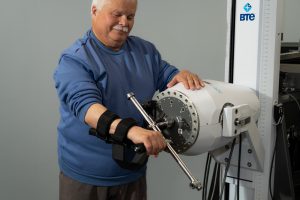
A system like the PrimusRS captures all four of these measurements plus facilitates functional exercise in one platform with automated reporting.
From Measurement to Dosing
Different deficits call for different loading:
| If the deficit is… | The loading emphasis becomes… |
|---|---|
| Peak force | Heavier resistance to rebuild maximal strength. |
| Power | Faster, more explosive contractions at moderate loads. |
| Endurance | Higher-repetition, sustained loading to restore fatigue resistance. |
| Velocity-specific | Training at the speeds where torque falls off. |
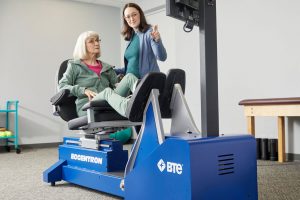
For patients who genuinely cannot tolerate heavier concentric loading, eccentric training is one well-supported option — it lets the quad handle meaningful load at lower perceived effort and cardiovascular demand. A clinical trial of Eccentron’s eccentric resistance training in knee OA reported improvements in strength, Timed Up-and-Go, sit-to-stand, and pain.7
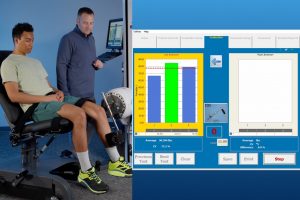
Just as important, every rep produces objective data. That is what turns a re-test into a defensible progress report — documenting medical necessity, justifying the dose, and showing payers and referrers measurable change in charts and graphs rather than “strength improving.”
Fitting It Into a Phased Program
The measurement profile does not replace good rehabilitation — it anchors it. Here is how the pieces sequence, with an objective checkpoint at each phase:
| Phase | Focus | What you measure |
|---|---|---|
| 1. Foundation | Patient education, pain settling, isometric activation, weight-management. | Pain levels, ROM, and swelling |
| 2. Restore | Range of motion and early strengthening (quad sets, straight-leg raises, targeted loading). | ROM and isometric force vs. baseline. |
| 3. Build | Progressive loading matched to the deficit profile — strength, power, or endurance emphasis. | Baseline profile: peak force, power, endurance, ROM. These can be measured between phases 2 and 3. |
| 4. Function | Functional and ADL loading, balance and fall-risk work, aerobic conditioning, benchmarks. | Functional benchmarks vs. baseline profile. |
Two pieces of that sequence are worth flagging. Patient education is not filler: reframing the belief that movement damages the joint is one of the highest-value things you do at evaluation, and structured education-plus-exercise programs such as GLA:D and the self-management approach recommended by the AAOS reduce pain and lower the desire for surgery. And because knee OA is an established fall-risk factor, objective balance measurement (for example, with the Alfa) belongs in the discharge phase, not just clinician observation.
What This Means for Your Clinic
Put simply: knee OA rehab doesn’t need more exercises — it needs the right load based on objectively measured strength metrics.
That precision is also what holds up under scrutiny: objective, repeatable data supports higher-value testing codes, strengthens documentation, and gives referral sources a reason to trust your outcomes. If you want to see how the measurement layer fits your program, explore BTE’s knee rehab equipment solutions or request a demo.