Objective Strength Testing: What Every PT and OT Clinic Needs to Know
Treatment Guidelines
Manual muscle testing is the most widely used strength assessment in rehab. Every PT and OT learns it, nearly every clinic uses it, and for confirming gross weakness or screening quickly at the bedside, it does a real job. It is not going anywhere — and it shouldn’t.
But here is something worth addressing: MMT was built to detect profound, obvious weakness; it grew out of the polio era, when the task was identifying muscles that had lost most of their function.1 We now lean on it for decisions it was never designed to support: the small, meaningful changes in strength, and the subtle side-to-side differences, that drive return-to-sport and return-to-work calls.
Objective strength testing doesn’t replace that clinical judgment. It gives the same clinicians a more precise instrument — quantifiable, repeatable force data — for the moments when “4/5, improving” isn’t enough to plan, document, or defend a decision.
So the rest of this piece is about where objective strength testing changes decisions: the deficits MMT can’t see, the handful of metrics worth measuring (and how to make patients actually care about them), and the reimbursement most clinics are leaving on the table.
Where Manual Muscle Testing Runs Out of Room
The problems with MMT are its highly subjective nature creating inconsistencies, and its inability to detect incremental changes in strength.
When one clinician grades a patient 4/5 and another grades the same patient 3/5, both may feel confident. But treatment plans, discharge timing, and return-to-activity clearance all shift on that one-grade difference — decisions made on data two clinicians in the same building might read differently.
The deeper issue is what a grade can’t capture. A patient recovering from an ACL reconstruction might gain real strength over three weeks of training, but if that progress falls entirely within a single MMT grade, it goes undetected and undocumented. That is not a knock on clinicians — it is a measurement ceiling: MMT’s sensitivity to side-to-side differences and to true deficits has been shown to top out below what rehab decisions require.2 You can’t report what you can’t measure, and you can’t justify continued care with a note that reads “strength 4/5, improving.”
What Objective Strength Testing Actually Is
Objective strength testing replaces subjective grading with quantifiable, reproducible force measurements from calibrated instruments. Instead of a clinician’s hand and judgment serving as the measuring device, the number comes from a system built to capture force output consistently.
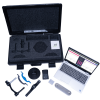
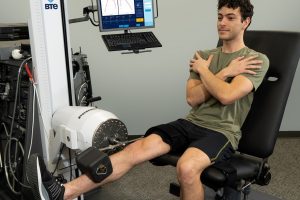
The technology sits on a spectrum. Handheld dynamometers are a portable, cost-effective entry point. Portable systems like the EVJ perform objective strength and range-of-motion testing anywhere, quickly. And at the comprehensive end, fixed dynamometry systems like the PrimusRS deliver isokinetic, isotonic, isometric, and CPM movement and measurement on one platform, combining evaluation and rehabilitation.
Here is the nuance worth getting right: putting a number on force is what makes the measurement objective — but a number is only as trustworthy as the method behind it. Standardization is the real driver of quality. Joint isolation, stabilization, consistent positioning, and eliminating compensatory movement are what separate reliable data from figures that merely look precise.
That is where integrated hardware and software earn their keep. When the system manages calibration, positioning, and data capture in one workflow, you get consistency across clinicians, across sessions, and across locations. The EVJ, for example, is designed so that uniformly calibrated tests performed in different locations produce reports that are stronger, more reliable, and legally defensible.
The Metrics That Matter (and How to Explain Them to Patients)
One of the biggest gaps in our field isn’t the data itself — it’s communicating what it means. And there is a real payoff to getting that right. BTE’s customers consistently report that patients love seeing their objective reports: for many, it’s the first time they’ve seen their condition or performance captured in real numbers, and that visibility builds confidence and buy-in that brings them back for the next visit.
Here are the metrics worth tracking, and a plain-language way to explain each:
| Metric | What it measures | How to explain it to the patient |
|---|---|---|
| Peak force | Maximum force in a single effort — your baseline, benchmark, and side-to-side comparison point. | “The strongest your muscle can push in one effort — like your personal best.” |
| Average force & endurance | Sustained force over a contraction window; reveals how quickly a muscle fatigues. | “Peak force is your sprint speed. Average force is the pace you can hold for a full mile.” |
| Torque | Rotational joint capacity in Newton-meters; accounts for limb-length differences between patients. | “Like a wrench. Torque is your effective turning power.” |
| Rate of force development & live force curves | How quickly and smoothly force is produced; reflects motor-unit recruitment, effort consistency, and pain inhibition. | “Not just how strong you are, but how fast you can switch that strength on — like acceleration in a car.” |
| Symmetry (side-to-side) | Percent difference between the involved and uninvolved limb; central to return-to-sport and return-to-work clearance. | “How closely your injured side now matches your healthy side — the number that says you’re ready to return.” |

Where Objective Strength Testing Matters Most
Orthopedic and sports rehab
Relying on subjective grading for athletes recovering from ACL tears, rotator cuff repairs, or ankle sprains frequently leads to premature return-to-sport clearance. Asymmetry detection isn’t optional in these populations — it’s the basis for a responsible clearance decision. The PrimusRS is used by elite athletic trainers and strength coaches for objective, data-driven testing and training.
Neurological and geriatric care
Objective testing helps differentiate true neurological weakness from disuse atrophy or deconditioning. Grip strength, in particular, serves as a fall-risk predictor and an overall health biomarker in older adults.3
Occupational health and workers’ compensation
Functional testing helps inform and justify decisions pre-hire, post-injury, and for return-to-work. EvalTech enables clinics to perform efficient, complete Functional Capacity Evaluations with automated reports — differentiating a practice with superior documentation for key hiring and return-to-work decisions.
Outpatient PT and OT
In everyday practice, objective data lets you hone in on exactly what an individual is dealing with. Systems like PrimusRS and Simulator II auto-generate reports, eliminating manual data entry and freeing clinicians to focus on treatment.
The Business Case: Documentation, Reimbursement, and ROI
This is the part few competitors talk about, and it may be the most important one for clinic owners.
Patient retention
Patients who see their progress visualized on screen stay engaged. They keep appointments and complete their plans of care. In an era of high copays, giving patients function-based goals benefits retention rates and clinical outcomes.
Stronger documentation means fewer denials
A quantified report showing a measurable deficit compared with the uninvolved side is fundamentally different from a note reading “strength 4/5, improving.” Objective measurement makes it easier to generate precise data that demonstrates medical necessity and supports reimbursement.
Higher-value CPT codes
Most clinics underutilize CPT 97750 for physical performance testing with a written report. Adding equipment that produces objective data opens this code, which typically reimburses at a higher rate than standard therapeutic exercise or activity codes. The computerized reports BTE systems generate provide the detailed written report the code requires, reducing administrative burden.
New revenue streams
Post-Offer Employment Testing is a major recurring revenue stream for many clinics. As reimbursement cuts, rising deductibles, and higher copays pressure the traditional rehab model, occupational health services offer diversification that doesn’t depend on traditional reimbursement.
Choosing the Right System for Your Clinic
The right system depends on your clinical focus and workflow:
| System | Best fit |
|---|---|
| EVJ | Mobile clinicians or satellite locations needing objective strength and ROM testing on the go. |
| EvalTech | Occupational health and FCE programs that need superior functional evaluations and automated reporting. |
| PrimusRS | Clinics that want to combine evaluation and treatment in one platform and maximize testing and exercise capacity. |
BTE also helps clinicians get the most from a new system, with training that extends beyond setup: ongoing support, one-on-one sessions, video tutorials, and more.
The Future of Rehab Is Objective
The shift from subjective grading to objective measurement is not really optional anymore. Value-based reimbursement, rising payer scrutiny, and patient expectations are all moving in the same direction. BTE built the first objective, functional rehabilitation device more than 45 years ago — and the company that started this evolution remains well positioned to guide clinics through it, equipping clinicians with technology that delivers measurable success.
If you’re ready to move from estimating to measuring, explore BTE’s evaluation product line or request a demo to see objective strength testing in action.