Task Simulation in Occupational Therapy: The Definitive Clinical Guide
Treatment Guidelines
Task simulation is the practice of replicating real-world activities, from job duties to daily self-care, inside a controlled clinical environment. It’s become a cornerstone of modern occupational therapy because it bridges the gap between what patients do in the clinic and what they actually need to do in life. But here’s the thing we don’t talk about enough: creativity alone isn’t enough.
The clinics that thrive with task simulation are the ones that pair functional activities with objective measurement. This guide covers the clinical science, industrial rehab applications, low-tech hacks, emerging technology, reimbursement strategy, and practical implementation, all through the lens of making every simulated task defensible, measurable, and reimbursable.
Here’s the narrative thread to hold onto: Without objective measurement, even the most brilliant simulation is just another exercise in the eyes of a payer or employer.
What Is Task Simulation and Why It Defines Modern OT
If you’ve ever watched a patient crush their Theraband exercises in the clinic and then struggle to open a jar at home, you already understand the problem task simulation exists to solve.
Task simulation is the replication of real-world activities, including job duties, ADLs, and IADLs in the clinic. Unlike traditional exercise-based rehab, where the focus is on isolated strength or range of motion, task simulation grounds every therapeutic activity in the functional demands a patient will actually face when they leave your clinic. Task simulation enables clinicians to accurately replicate job tasks for injured workers, and the same principle extends to anyone returning to daily life after injury, illness, or surgery.
Isolated movements like bicep curls and wrist flexion reps are foundational exercises in rehab. They rebuild the strength and neuromuscular control that functional tasks demand. But for patients with a specific goal, whether that’s lifting a child out of a crib or generating torque with a wrench overhead, isolated training is the beginning, not the end.
Task simulation bridges the gap between the strength built in the clinic and the demands of real-world function, giving patients the opportunity to apply and integrate those gains in ways that directly mirror what their lives and jobs require.
The Clinical Science: Why Task Simulation Works
Successful simulation must accurately match the physical demands of the target task. That means getting the body position, resistance, height, grip style, movement patterns, and endurance requirements right. This involves accurately matching the weight and handle of objects, meeting endurance and repetition requirements, and simulating lifting heights. A simulation that doesn’t respect the physics of the real task is just a themed exercise.
The Brain Reorganizes Around Practiced Function
The neuroscience here is compelling. The brain reorganizes around practiced functional patterns, not abstract movements. That’s why task-specific training produces stronger carryover than generic exercise. A recent Delphi study on OT’s future directions highlighted neuroplasticity-based interventions and simulation-based learning as key competencies for the profession going forward.
Cognition Is Part of the Simulation
We often think of task simulation as purely physical, but the cognitive dimension is just as important. Simulating a grocery shopping trip with a written list, for example, forces patients to manage physical mobility while simultaneously processing cognitive demands like sequencing, attention-switching, and problem-solving. That dual-task loading mirrors the real-world distractibility patients will face. VR and AR technologies are beginning to simulate everyday tasks in controlled settings, adding another layer of cognitive challenge to physical rehabilitation.
Confidence, Not Just Capacity
Simulation doesn’t just restore what a patient can do. It rebuilds their belief that they can do it. Workers and patients who have rehearsed the exact demands they’ll face return with less fear and greater psychological readiness. This is especially true in sports medicine, where simulating sport-specific movements makes a meaningful difference in athletes’ physical and psychological readiness to return to sport.
Industrial and Work Rehab Simulations: The Data-Driven Approach
If there’s one setting where task simulation carries the highest stakes, it’s occupational rehabilitation. The primary objective is to ensure a safe return to work, and the consequences of getting it wrong, either sending someone back too early or keeping them out too long, are significant for everyone involved.
Work Conditioning vs. Work Hardening
Work conditioning focuses primarily on physical restoration, using simulation so patients perform tasks closely mimicking their actual workday. Work hardening is more intensive and multidisciplinary, involving PT, OT, psychology, and vocational specialists. Both rely on simulation of critical work demands, with progression in frequency, load, and duration.
Grip, Torque, and Precision
Many jobs require very specific grips in very specific positions. A mechanic using a wrench must grip the tool in a certain way and produce enough torque to use it effectively. Matching these grip requirements in the clinic is essential for return to work.
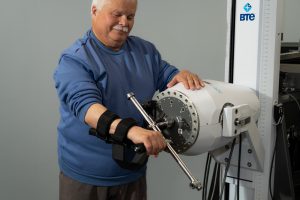
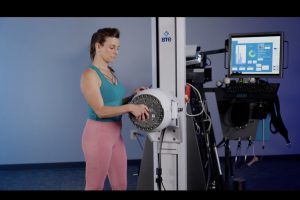
This is where purpose-built equipment makes a real difference. The PrimusRS allows clinicians to adjust finger position, wrist position, body position, activity height including overhead, and resistance mode, all to replicate the specific demands of a patient’s job. Changing the workhead height and angle unlocks creative clinical applications, from simulating a power drill overhead to operating tools near the ground.
Where Simulation Meets Legal Defensibility
Creativity is valuable, but it’s not enough when legal and financial systems are involved. In workers’ comp cases, clinicians must objectively measure and report torque, endurance, and ROM. PrimusRS’s data-driven assessment and dosing allow clinicians to quantify and report patient progress, which is particularly important for returning patients to physically demanding jobs.
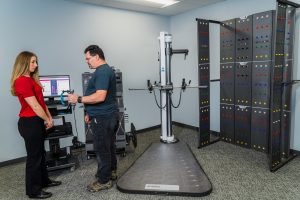
One clinic formed a revenue-generating partnership with a large local manufacturer using PrimusRS to provide objective assessment of employees’ capacity to complete specific work tasks and functional capacity evaluations. According to Sarah Holt, one of the lead therapists, the ability to customize each evaluation and exercise makes a world of difference for unique work rehab cases.
And let’s not forget: task simulation is also a teaching opportunity. Education around body mechanics, work pacing, injury prevention, and worker self-management is an essential complement to physical repetition.
Low-Tech Simulations: Clinical Creativity on a Budget
Not every clinic has computerized dynamometers. In SNFs, subacute settings, and home health, clinicians demonstrate remarkable ingenuity with everyday objects.
Weighted Swiffers simulate sweeping. Upside-down buckets simulate tub thresholds. Sticky-note scavenger hunts build executive functioning into physical mobility tasks. These are clever, and in the moment, clinically meaningful.
But here’s where we need to be honest about the limitations. First, most of these hacks don’t get particularly close to the real-life task they’re standing in for — a bucket is not a tub threshold, and the loading pattern, surface friction, and failure mode are all different enough that “close enough” carries real clinical risk. Second, they come with practical ceilings: you can’t easily grade resistance, isolate a plane of motion, or control for compensation the way a patient will need to when the task shows up in their actual bathroom or kitchen. Third, and maybe most important, they rarely offer performance-based progression. There’s no consistent way to say “you moved from X to Y” — no baseline, no repeatable measure, just a subjective sense that things look better.
On top of that, none of it produces a documentation trail. How do you prove progress on a bucket-step simulation to a payer? When patients are paying higher co-pays, why would they keep coming back to your clinic for a homemade drill they could just as easily do on their own?
That combination — imprecise simulation, no progression data, no defensible documentation — isn’t just an administrative headache. With co-pays climbing and payers scrutinizing every visit, it’s a missed opportunity to deliver value a patient can actually feel and a payer can actually see. A session built on hacky, halfway-real solutions makes it harder to justify why the patient needed a clinician in the room at all.
None of this means low-tech is useless. Cones, bands, sleds, kettlebells, and bodyweight stations can yield genuinely strong outcomes when paired with skilled movement analysis and a clear read on the patient’s functional goals. The creativity isn’t the problem — the gap is turning that creativity into something measurable. When clinics add objective data collection alongside their low-tech simulations, they build a documentation chain that holds up to scrutiny and gives patients a reason to stay engaged in care.
PrimusRS helps clinicians capture objective strength and functional data to generate automated, insurer-ready reports — bridging the gap between clinical creativity and reimbursable data.
Technology and Innovation in Task Simulation
The technology landscape in task simulation is evolving rapidly, and the clinics paying attention now will have a significant advantage.
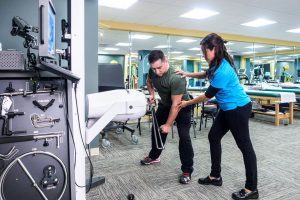
PrimusRS provides real-time data capture for any type of exercise, from fine isolated movements to functional activities. Multiple resistance modes, including isotonic, isometric, isokinetic, and CPM, allow clinicians to match the exact demands of a patient’s target task. Specialized attachments isolate joint movements and replicate ADLs and sports applications.
Simulator II enables clinicians to replicate hundreds of job tasks and ADLs for functional training that translates directly to daily life.
On the reporting side, clinicians can demonstrate patient progress throughout the course of treatment with objective reports from BTE systems. And instead of juggling multiple devices for testing and treatment, an integrated platform allows evaluation, treatment, and documentation on a single system.
Simulation Is the Standard. Measurement Is the Differentiator.
Task simulation has evolved from a creative clinical technique into a clinical imperative spanning work rehab, ADL training, cognitive rehabilitation, and sports medicine. The clinics that will thrive are those that pair task-specific ingenuity with objective, data-driven outcomes, producing documentation that defends skilled care, earns payer approval, and builds referral pipelines.
The future isn’t a choice between low-tech creativity and high-tech precision. It’s the convergence of both, anchored by data that makes every simulated task documentable, defensible, and reimbursable.