ACL Rehab Protocol With Concomitant Meniscus Repair: Why "Just a Slower ACL Rehab" Isn't Enough
Treatment Guidelines
Learn how meniscus repair changes ACL rehab, from weight-bearing and range-of-motion restrictions to the milestones that guide progression.
Six weeks post-op, the brace comes off, weight-bearing precautions lift, and on paper, the patient looks ready to fall into your standard ACL reconstruction timeline. This is exactly where an ACL rehab protocol with concomitant meniscus repair quietly goes wrong. Once formal precautions end, ACL-only and ACL-plus-meniscus-repair protocols start to look nearly identical, and clinicians who aren’t actively tracking the meniscus repair’s healing biology default back to a generic ACL reconstruction with meniscus repair rehab timeline. The patient is technically cleared, but the plan has quietly stopped accounting for tear type, repair location, and tissue healing rate. That gap is where a lot of this population’s setbacks originate.
A criteria-based ACL meniscus repair rehabilitation approach doesn’t ignore time; it just refuses to let time make the decision alone. Time-based milestones set the floor for how early you can even consider progressing. Whether you actually advance depends on what the tissue is telling you: effusion response, pain behavior after loading, quad activation, and movement quality. A patient at week 7 who’s swelling every session isn’t ready for the same load as a week 7 patient who tolerates closed-chain work cleanly, even if both had the same procedure on the same date.
Why Repair Type Changes Everything
Physical therapy after ACL reconstruction and meniscus repair can’t be templated the same way across tear patterns. In fact, many institutional protocols lack specific modifications for meniscal involvement, especially in the late stage return-to-sport phase.1 Before you prescribe a single exercise, you need the surgical details: tear pattern, repair location (medial, lateral, or both), fixation method, and any surgeon-specific flexion or weight-bearing limits. That conversation matters more here than in almost any other knee case, though the day-to-day work of rehab still comes down to watching how the joint actually responds to load.
Vertical longitudinal repairs in a well-vascularized peripheral zone tend to be the most forgiving pattern in this population. They generally tolerate earlier flexion and progressive loading, and the biology supports a more standard timeline once fixation is confirmed stable.
Bucket-handle repairs involve a larger displaced fragment and more suture load, so early flexion is often restricted further and closed reduction stability needs to be respected longer before you push range aggressively.
Radial tears disrupt the meniscus’s circumferential fibers, which are what let it resist hoop stress in the first place. Repairs here are often more vulnerable to shear, so rotational loading, pivoting and cutting gets delayed well beyond when straight-plane strength work resumes.
Ramp lesions frequently travel with posteromedial capsular involvement, adding instability considerations on top of the meniscus repair itself. Flexion progression and closed-chain loading need to account for that combined picture, not just the tear in isolation.
Meniscal root repairs are usually the most conservative case in this group. Root fixation is far less tolerant of shear and rotational stress than a peripheral suture repair, so weight-bearing and flexion limits commonly extend well past the standard six-week mark, and return-to-impact criteria are typically stricter on the back end too.
Complex or multiple tears generally call for the most conservative approach of all, since you’re managing the combined healing constraints of each repair rather than picking whichever is least restrictive.
The Protected Loading Progression
Weeks 0–2: Protect Without Underloading
Early goals are unglamorous but non-negotiable: manage pain and swelling, restore full passive extension, and get the quad firing again. Cryotherapy and neuromuscular electrical stimulation help control inflammation and combat quad inhibition, but the bigger risk in this window isn’t overloading the repair, it’s excessive caution that lets the quad shut down and motion stall.
Early quad sets, patellar mobilizations, and heel slides within the surgeon’s flexion limits keep the nervous system engaged without stressing the repair site.
Weeks 2–6: Building Capacity
This is where flexion limits and weight-bearing status typically progress, but progression should track how the knee responds, not just the calendar. When a meniscus repair is performed concurrently with ACL reconstruction, early weight-bearing restrictions (often 2–6 weeks of protected loading) and knee flexion limits (typically capped at 90° during loaded exercises) are enforced to protect the repair site. This initial delay in full loading inevitably slows early quadriceps activation and hypertrophic recovery, pushing the onset of high-impact loading and running readiness further down the timeline compared to an isolated ACLR.
The specifics of that restriction, though, should be dictated by the repair itself rather than a blanket rule. The tear types and locations discussed earlier carry directly into this phase. For example, a stable, minor repair in a well-vascularized zone often tolerates more weight-bearing knee flexion and looser restrictions overall. On the other hand, an unstable or complex repair may need weight-bearing limited for longer so the tissue has time to become tolerant.
In reality, many protocols still avoid any weight-bearing flexion for the first 5-6 weeks regardless of repair quality. Some hold off full weight-bearing for six weeks by default, a pattern that’s more often about overprotection than hard evidence. Given how much this varies by repair type, location, and stability, direct communication with the surgeon is essential.
Increasing effusion or pain with each advancement is a signal to hold, not push through.
Closed-chain exercise in protected ranges, hip and core strengthening, and gait normalization dominate this phase.
On the flip side, this is also where the underloading trap tends to set in. Clinicians who are cautious by default can leave capacity on the table simply because six weeks hasn’t arrived yet, even when the tissue would tolerate more.
This phase is also the key window to prioritize cross-training and loading the uninvolved limb. Training the healthy leg keeps the patient active, and leverages the crossover effect, meaning strength gains on the uninvolved side produce a measurable neural carryover to the involved limb. This effect can help offset atrophy. Upper-body and cardio training round out this phase, preserving overall conditioning while the knee builds tolerance.
Weeks 6–12: Transitioning to Normal Loading
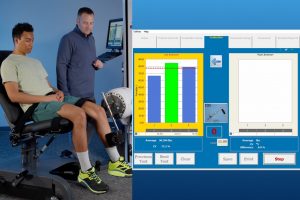
Once formal precautions lift, resist the pull toward a purely time-based template. Confirm what “brace off” actually means for this specific repair before treating it as full clearance. Stationary biking, expanded closed-chain strengthening, single-leg balance work, and when the repair pattern allows, open-chain knee extension in a limited arc can begin here, guided by objective strength testing and dynamometry rather than assumption. Again, if effusion or pain climbs each time you advance a variable, that’s the tissue telling you to hold the current load rather than adding another step because the calendar says you can.

Advanced Rehab and Return to Sport
3–6 Months: Strength and Running Readiness
Before running or high-impact plyometrics enter the plan, explicit clinical criteria must be met: a Quadriceps Limb Symmetry Index (LSI) of at least 80–85% (progressing to >90% for explosive loading), full symmetrical knee extension, a clean effusion response (trace/zero swelling post-activity), and sound single-leg landing mechanics.
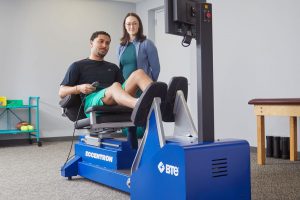
Eccentric strengthening tools like Eccentron are useful here for building quad and hamstring capacity while controlling load precisely, and there’s a growing body of published research on eccentric training after ACL reconstruction supporting that approach for strength and tendon health.
Want a deeper dive? Our free e-book, ACL Recovery Unlocked, breaks down the latest EMG research, case studies from athletic trainers, and practical ways to apply eccentrics in your own ACL protocols.
6–9+ Months: Plyometrics, Agility, and Return-to-Sport Testing
Progression to jumping, cutting, and deceleration work should be criteria-driven,2 not tied to a fixed week number. In practice, that means quadriceps and hamstring limb symmetry index values of roughly 90% or better on dynamometry, single-leg and triple hop tests within about 90% symmetry, a clean agility t-test, and no reactive effusion in the 24 hours after a loading session.
None of these numbers substitute for the others; a patient can pass a hop test on compensation patterns that a movement-quality screen would catch. Root repairs and complex tear patterns generally warrant more conservative return-to-impact criteria than a small, stable vertical repair, even at the same point on the calendar, and psychological readiness (measured through patient-reported confidence and willingness to load the limb), not just physical output, belongs in the return-to-sport decision alongside the numbers.
Keep the Surgeon in the Loop at Key Transitions
Surgical details gathered at the initial evaluation: tear pattern, repair location, fixation, and any additional procedures only stay useful if you revisit them at the moments the plan actually changes.
The six-week precaution review is one of those moments: confirm whether a restriction is lifting because enough time has passed or because there’s evidence of tissue healing, and don’t assume “brace off” means the meniscus-specific limits disappear too. The same check applies again before advancing to running or plyometric loading. Advocating for a quick conversation about biological readiness for impact, not just time-eligibility, can prevent a setback a criteria checklist alone might miss.
Troubleshooting: Reading the Signs
Persistent medial joint-line pain, anterior knee pain after graft harvest, a rigid or compensatory gait, or swelling that keeps returning after activity are all worth investigating rather than pushing through. A patient with lingering extension loss and a rigid gait pattern three months out isn’t automatically a rehab problem to push through harder and it’s worth ruling out a post-op complication first. Knowing when to escalate back to the surgical team is as much a part of criteria-based practice as knowing when to progress.
The underloading trap deserves its own attention, because it’s the failure mode that’s easiest to miss. For example, a patient who’s guarded, quiet in their quad activation, or moving hesitantly weeks after they should be building capacity isn’t automatically protecting the repair; they may simply be under-loaded relative to what the tissue can tolerate. The fix is training the quad, hip, and trunk early and consistently even while flexion or weight-bearing limits are in effect, so the nervous system stays engaged through the restricted phase instead of going quiet and needing to be re-recruited later.
On the other hand, fear of movement (kinesiophobia) shows up differently than physical guarding, and it’s common enough in this population that it’s worth screening for directly rather than assuming hesitancy is purely mechanical. Graded exposure and starting with movements the patient can perform successfully and building from there helps rebuild trust in the limb incrementally. Visualization techniques and, when fear is significantly limiting participation, a sports psychology referral can be appropriate additions rather than a sign the rehab plan has failed. Setting realistic, staged expectations early tends to reduce how much fear compounds later in the timeline.
Lastly, nutrition is a smaller lever but a real one: adequate protein intake, an anti-inflammatory eating pattern, and consistent hydration give healing tissue what it needs to keep pace with the loading program. It won’t overcome a loading plan that’s off, but a patient who’s under-fueled can blunt otherwise appropriate progress.
Practical Considerations for the First Few Weeks
The first two to four weeks are as much about the home environment as the clinic. Stairs, showering, and sleep positioning are common friction points. A shower chair and a plan for one-handed showering, a firm sense of how to navigate stairs safely on crutches, and a comfortable resting position that doesn’t stress extension all reduce the chance of a fall or a compensatory movement pattern that undermines the early goals.
Removing loose rugs and clearing walking paths matters more than it sounds like it should; a stumble in week two can set a patient back further than a missed exercise session. These aren’t clinical milestones, but coaching patients through them early tends to pay off in adherence and confidence later in the plan.
Building an Effective ACL Rehab Equipment Setup
None of this works without the right tools to actually measure what’s happening in the knee. A well-equipped clinic pairs ACL rehab equipment for progressive strengthening with knee rehabilitation equipment built for objective tracking, so decisions about advancing a patient are based on data rather than the calendar alone.
The Bottom Line
An ACL rehab protocol with concomitant meniscus repair isn’t a slower version of a standard ACL timeline. It’s a different plan shaped by tear type, repair location, and how the tissue actually responds to load. Time sets the earliest point you can consider a progression; objective criteria decide whether you actually take it. Watch effusion, pain response, and function case by case, keep the surgical details in view, and don’t let a cleared brace or a passed week-count substitute for evidence that the repair is truly ready.