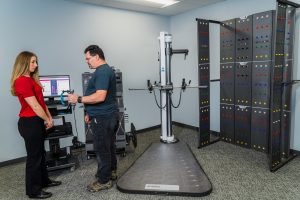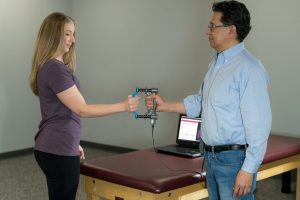

Many rehabilitation clinicians have faced challenges in clinical decision-making due to inconsistent patient performance. For example, what we see in the clinic might not match a patient’s reported limitations. Without objective data to back in-clinic performance, we may be left making more judgment calls about treatment progression than we’d like.
Consistency of effort (COE) testing gives clinicians a data-backed way to evaluate performance within a session and over time. It provides a clearer picture of patient behavior and symptom fluctuations, which can support defensible documentation and help you determine the next appropriate steps in a treatment plan.
In this article, you’ll learn why COE testing is useful and how to perform it. You’ll also learn how to interpret results and what to do next if you notice inconsistencies.
Understanding Consistency of Effort Testing
COE testing is when a clinician measures a patient’s maximal (or optimal) effort during performance. This data is compared to other attempts to determine how stable their performance may be.1
Usually, COE testing is used during work conditioning to assess whether a patient is providing consistent effort during rehabilitation. It’s also frequently used in functional capacity evaluations to determine whether a patient is stable enough for discharge in high-stakes cases, like personal injury or disability claims. COE data is especially important to stakeholders when:
- A claim has been open for a long time with stagnated progress
- Treatment costs are relatively high for the injury severity
- A patient’s reported limitations don’t match the documentation
But COE testing is also helpful in traditional rehabilitation. Inconsistent effort may indicate mental barriers or symptom fluctuation, which can be addressed throughout treatment for better patient outcomes.
Consistency of Effort vs. Sincerity of Effort
COE testing is often interchanged with sincerity of effort (SOE) testing, but they aren’t the same. The primary difference lies in how we interpret the data.
SOE may limit what clinicians consider a hindrance to performance because it implies inconsistent effort may always be intentional. It’s true that some patients receiving workers’ compensation may exaggerate symptoms for financial gain or other ulterior motives.2 However, assuming that performance fluctuations are always due to malingering can lead to uncomfortable patient conversations and ineffective treatment.
COE helps us look at the bigger picture. Studying performance consistency independent from sincerity allows clinicians to consider other factors that may impact performance. These include:
- Pain
- Fear
- Fatigue
- Symptom variability
- Misunderstanding instructions
- Low confidence
- Cognitive or neurological deficits
Considering these factors first helps us avoid accusatory conclusions and interpret findings in context.

When to Use Consistency of Effort Testing
COE testing is clinically meaningful when used in certain clinical situations. Below, you’ll learn when to use it and how to best prepare for it.
Clinical Situations Where COE Testing Is Helpful
COE testing is most helpful in the following situations:
- Functional capacity evaluations: Third-party payors often look for COE tests to determine whether a patient needs continuing care or should be discharged. Without COE, clinical recommendations might be harder to defend.
- Workers’ compensation: COE data may also help defend clinical recommendations when employers and case managers are involved in return-to-work decisions.
- Mismatched functional limitations: Sometimes, a patient reports they can’t do an activity, but they show otherwise in the clinic (or vice versa). COE testing can help clarify the extent of this functional limitation gap and provide objective data to back it.
- Insufficient information: If you’re unsure how to progress treatment and justify your decision, COE testing can provide additional performance insight and objective data for defensible documentation.
What Clinicians Need Before Testing
Before performing COE tests, clinics may want to establish a systematic process to make sure assessments remain consistent when performed by the same or different clinicians. This process may involve some training. Consider the following:
-
- Standardized instructions: Every clinician should provide the same verbal instructions and resist coaching to influence results.
- Consistent test setup: Equipment position and environment should be the same every time, and clinicians should document settings clearly for reference when repeating methods later.
- Neutral documentation practices: To avoid accusatory language and reduce clinic liability, clinicians should focus on objectively reporting COE data.
- Interpretation and use strategies: Every clinician should enter testing having considered possible scenarios, so they can effectively explain results to the patient and develop an appropriate plan.
Methods for Testing Consistency of Effort
Clinicians can use COE testing in various ways, depending on the evaluation’s goal. Below are two methods, and when they may be appropriate.
Repeated-Trial Methods
The repeated-trial method involves the patient performing multiple repetitions of the same action during the test. This method can evaluate whether performance is stable across multiple attempts.
Using this testing method can help clinicians establish a baseline for goal-setting or evaluate performance consistency over a short period.
During repeated trials, you may want to observe how patients behave. For example, you might look for compensation or guarding when fatigue occurs, changes in breathing patterns, or other context clues to provide supporting information.
Cross-Test Comparisons
The cross-test method compares one COE test to another. This method can evaluate overall functional capacity by assessing whether tests show similar results.
Using this testing method can help clinicians identify performance gaps that require further evaluation. While it may not explain why gaps appear, clinicians can use the information to guide where to look next.
You may also want to compare performance quality and behavior during each test as supporting context. For example, you might listen to how patients describe how they feel during each test, or observe whether they show apprehension during one test over another.
Interpreting Results and Making Clinical Decisions
Once you have COE test results, it’s time to interpret them. Find information below regarding performance indicators, how to interpret them, and how to move forward in clinical decision-making.
Coefficient of Variation and Other Indicators of Performance Consistency
While there isn’t a widely accepted standardized protocol for COE testing, the coefficient of variation (CV) is one of the main methods to calculate results.2
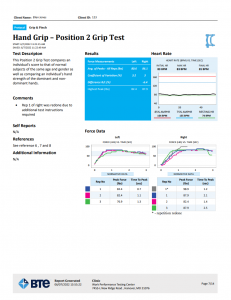
CV is a measure of how repeated scores differ from their average. It’s represented as a percentage. Basically, a low CV means performance was consistent, while a high CV means performance wasn’t consistent.3
But using the CV alone to interpret results has disadvantages. Unlike outcome measures with established ranges or cutoffs, one study suggests that a CV’s traditional 15% cutoff may not be sensitive enough to differentiate between high and low consistency. It also suggests that fewer repetitions during a test might result in a less accurate CV.4
For this reason, it’s important to use other measures and clinical observations as performance indicators as well to provide more context. The same study mentioned above, for example, found more variability in submaximal than maximal COE testing. This means interpreting CV as low or high might require more clinical judgment at submaximal efforts, and additional context to guide your judgment could be helpful.
What Consistent, Inconsistent, and Mixed Findings May Indicate
While you can’t make definitive conclusions from COE testing, you can use the data to support clinical reasoning. Here’s what the results may mean:
- Consistent (low CV): The patient performed similarly across trials, allowing you to make clinical decisions confidently based on this stable set of data.
- Inconsistent (high CV): The patient’s performance varied across trials, suggesting you should investigate why the data is unreliable before making confident clinical decisions.
- Mixed (high and low CVs): Data was sometimes consistent and sometimes inconsistent across tests, so further investigation is needed to track down the performance gap.
Why Results Must Be Interpreted in Context
Clinicians should always interpret results holistically, considering all aspects of the patient’s presentation. This means assessing objective COE findings alongside clinical observations during testing, including quality of attempts, overall behavior, medical history, and current diagnosis.
COE testing should inform clinical decisions about treatment and discharge planning rather than defining them.
What Inconsistent Data May Mean
Inconsistent data is traditionally interpreted as an insincere effort. While this could be the case and is worth consideration, it would be remiss not to investigate other reasons why performance fluctuates.1 The context clues mentioned above can help you understand where to look and what questions to ask.
Consider the following situations, for instance:
- You introduce maximal grip strength COE testing to your patient, and they ask multiple questions before they begin, exhibiting anxiety. During a repeated-trial method, they’re fearful during the first five attempts, then slowly increase effort during the last five when they realize the test isn’t painful.
- You perform grip strength COE testing in different wrist positions, but the patient is fearful of gripping in one position over another. They drift out of the testing position every other attempt despite correction, leading to inconsistent results.
How BTE Systems Supports Objective COE Testing
At BTE, we develop evidence-based rehabilitation equipment to provide objective measurement of functional activity. Clinicians use our evaluation tools for quick COE testing with automated reports showing CV calculations next to the client’s performance graphs showing left-right comparison and normative data.
Action Steps After Data Interpretation
After interpreting data using the CV and clinical observations, you’ll need to decide what to do next. Consider the guidance below.
What to Do Next if Results Show Inconsistency
If results are inconsistent, you need to investigate why. Be sure to look at inconsistent results with a curious eye, not a critical one. Rule out causes of inconsistent results before documenting, as another stakeholder’s interpretation may affect the patient’s future care.
If you have an idea of where the inconsistency is coming from, start your problem-solving there.
Did the patient misunderstand instructions? Was the test set up incorrectly? These questions may signal procedural issues and require retesting.
Did the patient’s performance decline progressively, or did a behavior suddenly cause a drop in performance? These questions may signal symptom-related issues and require clinical judgment to use different testing conditions or stop testing for now.
Is the source of the inconsistency still unclear despite your investigation? Or, are there multiple sources affecting performance? Document results with what you observed and add any additional information from the session that could help provide context. Use data cautiously when planning treatment. You may try COE testing again during the next session, if necessary.
How Findings May Affect Rehab Planning and Return-to-Work Decisions
COE findings give clinicians confidence and justification when rehab planning and determining readiness for work. For third parties, it’s a potential indicator of insincere effort and may impact future rehab planning, but it’s our job as clinicians to look for additional clues before jumping to conclusions of malingering.
Consistent performance data, even when performance is poor, provides clinicians with a clear understanding of where the patient stands and what the next steps toward discharge should be. Inconsistent performance data suggests missing context needed for treatment planning or return-to-work recommendations. Mixed results across multiple tests might indicate a performance gap due to an outstanding functional deficit, which may require additional care to address.
How to Communicate Consistency of Effort Findings
Carefully communicating COE findings may be just as important as the testing itself. Here’s what you should consider when discussing and documenting results.
How to Discuss Results with the Patient
When discussing results with a patient, stay neutral and report the findings. If they’re inconsistent, say so without implying their intent. You may want to focus on the next steps, like gathering contextual information.
For example, instead of saying, “Your test results varied more than it has before. Were you giving full effort as I instructed?” You may want to ask a more open-ended, exploratory question: “How did this test feel compared to last time?”
How to Communicate Findings to Employers, Case Managers, Payers, or Other Stakeholders
You’ll also want to clearly and carefully communicate COE testing results with stakeholders, including employers, case managers, and third-party payors.
These stakeholders often look for COE findings to determine how much care is deemed appropriate and define return-to-work timelines. Implying (intentionally or not) that a patient didn’t give full effort without sufficient supporting evidence can carry heavy consequences for the patient.
If you mention any results in person or over the phone with a case manager (for example), you may want to follow up with documentation to keep a record.
How to Document Findings Without Overstating Conclusions
Document COE results just as you’d report them to a patient or a stakeholder: objectively. State the result with your clinical observations without overstating the interpretation of sincerity unless blatantly obvious (as in, said so by the patient). Only say what you can support with evidence.
You may write, “Patient demonstrated variable performance across trials with a CV of 55%.” But you might not want to write this unless you have sufficient evidence: “Patient appears to limit effort intentionally during testing, resulting in a CV of 55%.”
If there are contributing factors that may have affected performance, document them to provide context to the session. If not, don’t overreach with hypotheses, as it could have legal and ethical ramifications for the patient.
You’ll also want to document testing conditions, methods, and settings — not only for stakeholders but also for future reference by you or another clinician.
Using COE Testing to Strengthen Clinical Process
A consistent approach helps improve testing administration, interpretation, communication, and decision-making across all cases and clinicians. This is especially important when multiple parties are involved.
A consistent process makes it easier for clinicians to know if performance inconsistencies are patient-driven (rather than procedural mistakes) and where to look next. It also helps clinicians document results clearly without overstating them.
If helpful, consider implementing standardized COE testing procedures for clinicians. This may include:
- A dedicated testing area to keep environmental factors and test setup as controlled as possible
- Fixed grip strength dynamometer with regular calibration schedule
- Scripts from where clinicians read testing instructions with recommended language when correcting behavior or discussing results
- Templated fill-in-the-blank documentation already using clinic-approved language available to paste into objective findings
Key Takeaways for Clinics Using Consistency of Effort Testing
COE testing helps clinicians gather more objective data about performance consistency to help inform care, especially in high-stakes cases. Inconsistent performance has many possible explanations, and using standardized testing alongside clinical judgment helps clinicians make responsible, confident decisions.
Objective measurement systems, like the BTE Prism, Simulator II, and PrimusRS, can standardize the testing process, provide reliable data, and offer easy ways to report findings. Learn more about BTE’s functional testing equipment for industrial rehab clinics.